Introduction
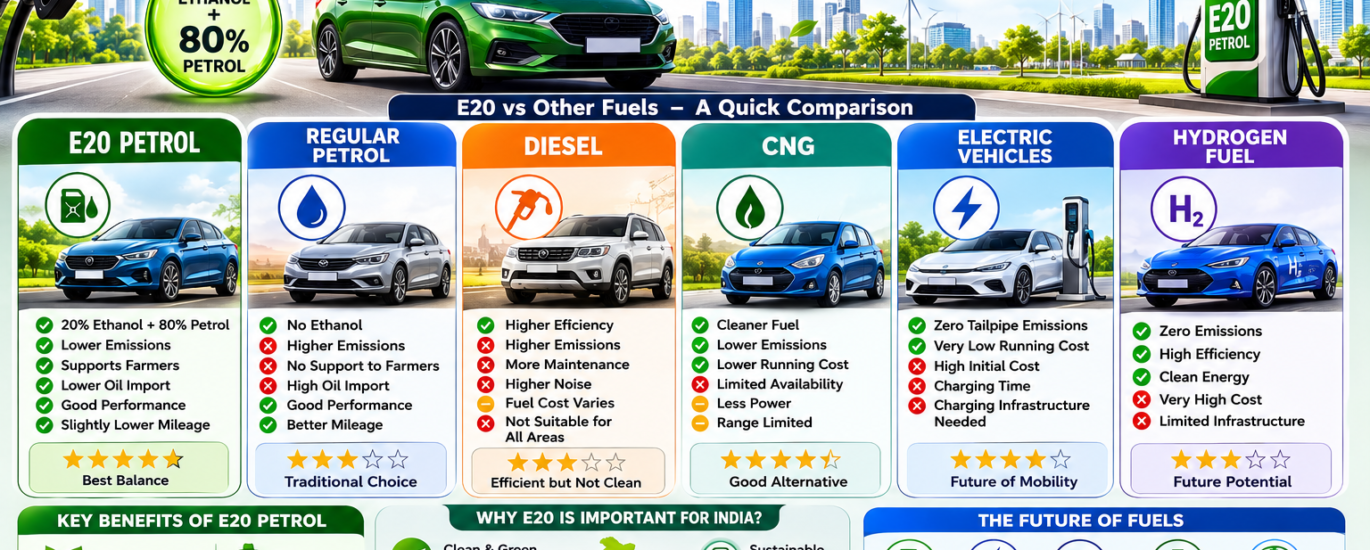
E20 Petrol vs Petrol: The automotive industry is undergoing a major transformation as countries seek cleaner, more sustainable transportation solutions. Traditional petrol and diesel vehicles are now joined by alternatives such as E20 petrol, CNG, electric vehicles (EVs), flex-fuel vehicles, hydrogen fuel-cell vehicles, and advanced biofuels.
Among these, E20 petrol has emerged as an important transition fuel in India. It enables existing petrol-engine technology to become cleaner by blending renewable ethanol with conventional petrol.
This article compares E20 with other major automotive fuels to help consumers understand their advantages, limitations, and future role.
What Makes E20 Different?
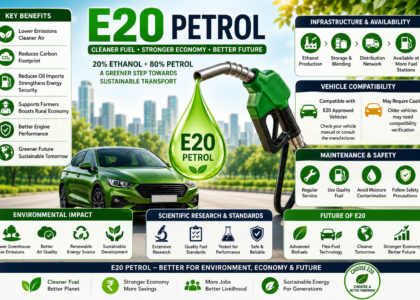
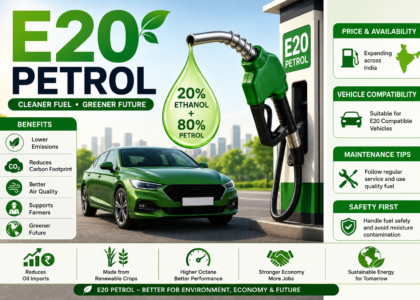
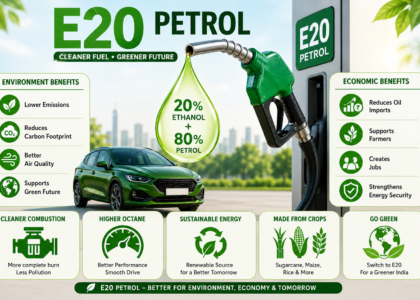
Unlike conventional petrol, E20 contains:
- 20% Ethanol
- 80% Petrol
Because ethanol is produced from renewable agricultural feedstocks, E20 reduces dependence on imported crude oil while helping lower lifecycle greenhouse gas emissions.
E20 Petrol vs Regular Petrol
| Feature | E20 Petrol | Regular Petrol |
|---|---|---|
| Ethanol Content | 20% | Usually 0–10% |
| Renewable Content | Higher | Lower |
| Emissions | Lower | Higher |
| Oil Import Dependence | Lower | Higher |
| Mileage | Slightly Lower | Slightly Higher |
| Octane Rating | Generally Higher | Standard |
| Supports Agriculture | Yes | No |
Which Is Better?
For vehicles approved by the manufacturer, E20 offers environmental and energy-security benefits while maintaining similar driving performance.
E20 Petrol vs Diesel
Diesel engines have traditionally offered better fuel efficiency but also produce different emissions.
| Feature | E20 Petrol | Diesel |
|---|---|---|
| Fuel Type | Petrol Blend | Diesel |
| Engine Type | Petrol Engine | Diesel Engine |
| Renewable Content | Yes | Limited |
| Carbon Emissions | Lower Lifecycle | Higher Fossil Fuel Dependence |
| Noise | Quieter | Louder |
| Maintenance | Generally Lower | Often Higher |
| Cold Start | Easier | Can Be Challenging in Cold Conditions |
Key Difference
E20 is intended for petrol engines only. Diesel engines must never be fueled with E20 petrol.
E20 Petrol vs CNG
Compressed Natural Gas (CNG) is another cleaner fuel option.
| Feature | E20 Petrol | CNG |
|---|---|---|
| Fuel Source | Petrol + Ethanol | Natural Gas |
| Renewable Component | Yes | Generally No |
| Refueling Time | Fast | Fast |
| Driving Range | Good | Depends on Tank Size |
| Fuel Availability | Expanding | Limited in Some Areas |
| Engine Modification | None (Compatible Vehicles) | Dedicated or Converted Vehicles |
Which Is Better?
The answer depends on driving needs, infrastructure, and vehicle compatibility.
E20 Petrol vs Electric Vehicles (EVs)
Electric vehicles operate using batteries instead of internal combustion engines.
| Feature | E20 Petrol | Electric Vehicle |
|---|---|---|
| Fuel | Petrol + Ethanol | Electricity |
| Tailpipe Emissions | Lower | Zero Tailpipe Emissions |
| Refueling | Minutes | Charging Required |
| Infrastructure | Existing Fuel Stations | Charging Network |
| Long-Distance Travel | Convenient | Depends on Charging Availability |
| Renewable Potential | High | Depends on Electricity Source |
Can EVs Replace E20?
Not immediately.
E20 and EVs are expected to complement each other during the transition to cleaner transportation.
E20 Petrol vs Hydrogen Fuel
Hydrogen fuel-cell technology is another emerging solution.
| Feature | E20 Petrol | Hydrogen Fuel Cell |
|---|---|---|
| Technology | Internal Combustion Engine | Fuel Cell |
| Fuel Availability | Expanding | Limited |
| Infrastructure | Existing Petrol Stations | Developing |
| Vehicle Cost | Lower | Higher |
| Commercial Availability | High | Limited |
Hydrogen has long-term potential but currently requires significant infrastructure development.
E20 Petrol vs Flex-Fuel Vehicles
Flex-fuel vehicles are designed to operate on a wider range of ethanol blends.
| Feature | E20 Vehicle | Flex-Fuel Vehicle |
|---|---|---|
| Maximum Blend | E20 | Up to E85 or Higher (Model Dependent) |
| Engine Calibration | Fixed | Adaptive |
| Fuel Detection | No | Automatic |
| Fuel Flexibility | Limited | High |
E20 Petrol vs Bio-CNG
Bio-CNG is produced from organic waste.
Comparison:
- E20 uses renewable ethanol.
- Bio-CNG uses renewable methane.
- Both support cleaner transportation.
- Both reduce fossil fuel dependence.
E20 Petrol vs Synthetic Fuels
Synthetic fuels are produced using advanced chemical processes.
Advantages:
- Lower carbon footprint (when produced sustainably)
- Compatibility with existing engines in some cases
Challenges:
- Higher production costs
- Limited availability
- Developing technology
Environmental Comparison
| Fuel | Renewable Component | Emission Reduction Potential |
|---|---|---|
| Regular Petrol | Low | Low |
| Diesel | Low | Moderate |
| E20 Petrol | High | Good |
| CNG | Moderate | Good |
| Electric Vehicle | Depends on Electricity Source | Very High |
| Hydrogen | High (Green Hydrogen) | Very High |
Infrastructure Comparison
| Fuel | Existing Infrastructure |
|---|---|
| Petrol | Excellent |
| E20 | Rapidly Expanding |
| Diesel | Excellent |
| CNG | Moderate |
| Electric | Growing |
| Hydrogen | Limited |
Consumer Benefits of E20
Consumers can benefit from:
- Cleaner combustion
- Reduced dependence on imported fuel
- Similar driving experience in compatible vehicles
- Renewable fuel usage
- Support for domestic agriculture
Industrial Benefits
Industries benefit through:
- Biofuel production
- Distillery expansion
- Equipment manufacturing
- Logistics
- Agricultural processing
National Benefits
At the national level, E20 contributes to:
- Energy security
- Foreign exchange savings
- Cleaner transportation
- Rural development
- Sustainable economic growth
Challenges Compared with Other Fuels
Some challenges include:
- Compatibility of older vehicles
- Expansion of ethanol production
- Public awareness
- Infrastructure investment
- Feedstock availability
Future Fuel Landscape
The transportation sector is expected to include multiple energy solutions working together.
Likely future fuels include:
- E20 Petrol
- Higher Ethanol Blends
- Electric Vehicles
- Hydrogen Fuel Cells
- Sustainable Aviation Fuel
- Advanced Biofuels
- Renewable Diesel
- Synthetic Fuels
Rather than a single solution replacing all others, different fuels are expected to serve different applications based on technology, infrastructure, and user needs.
Should You Choose E20?
If your vehicle manufacturer recommends E20:
✔ You can use it confidently.
If your vehicle is not approved:
✔ Follow the manufacturer’s fuel recommendation.
Choosing the correct fuel helps maintain:
- Engine reliability
- Fuel efficiency
- Warranty compliance
- Long-term performance
Final Thoughts
E20 petrol represents a practical and realistic step toward cleaner transportation. It leverages existing internal combustion engine technology while increasing the use of renewable energy.
As India’s ethanol production, infrastructure, and vehicle compatibility continue to improve, E20 is expected to remain a key component of the country’s sustainable mobility strategy.
Consumers should stay informed, follow manufacturer recommendations, and recognize that the future of transportation is likely to involve multiple clean-energy technologies working together rather than relying on a single fuel source.
50 SEO-Friendly FAQs About E20 Petrol (Part 5) – FAQ 401 to 450
Vehicle Compatibility
401. Can E20 petrol be used in all new petrol cars?
Only if the vehicle manufacturer approves E20 compatibility.
402. How can I confirm E20 compatibility?
Check the owner’s manual, fuel lid label, or contact the manufacturer.
403. Can E20 be used in automatic transmission cars?
Yes, if the engine is E20 compatible.
404. Can manual transmission cars use E20?
Yes, when approved by the manufacturer.
405. Does transmission type affect E20 usage?
No, engine compatibility is the key factor.
406. Can E20 be used in SUVs?
Yes, if the SUV is designed for E20.
407. Can hatchbacks use E20 petrol?
Yes, in compatible models.
408. Can sedans use E20 fuel?
Yes.
409. Can E20 be used in MPVs?
Yes, if manufacturer-approved.
410. Does engine size matter?
Compatibility depends on design, not engine size alone.
Fuel Usage
411. Can I top up E20 with regular petrol?
Yes. Mixing occurs naturally, though it’s best to use the fuel recommended for your vehicle.
412. Can E20 be used on long road trips?
Yes.
413. Is E20 suitable for city driving?
Yes.
414. Can E20 be used in hot weather?
Yes.
415. Can E20 be used during the rainy season?
Yes.
416. Can E20 be used at high altitudes?
Yes, provided the vehicle is compatible.
417. Does E20 require a full fuel tank?
No.
418. Should I empty my old petrol before filling E20?
No, it’s generally not necessary.
419. Can I switch between E10 and E20?
Yes.
420. Does fuel blending happen automatically in the tank?
Yes, when different petrol blends are mixed.
Safety
421. Is E20 safe for everyday driving?
Yes, in approved vehicles.
422. Can E20 catch fire?
Yes, like conventional petrol, it is highly flammable.
423. Should fuel containers be certified?
Yes.
424. Can E20 be stored at home?
Only in approved containers and according to local safety regulations.
425. Is smoking near E20 dangerous?
Yes.
426. Should children handle fuel?
No.
427. Is proper ventilation important?
Yes.
428. Can fuel spills damage paint?
Fuel can affect some painted surfaces if not cleaned promptly.
429. Should fuel spills be cleaned immediately?
Yes.
430. Can E20 produce harmful vapors?
Like petrol, fuel vapors should not be inhaled unnecessarily.
Environment
431. Why is ethanol considered renewable?
Because it is produced from crops that can be grown again.
432. Does E20 reduce fossil fuel consumption?
Yes.
433. Can E20 help improve urban air quality?
It can contribute to cleaner air through lower emissions.
434. Does E20 support cleaner transportation?
Yes.
435. Can E20 help reduce greenhouse gases?
It helps lower lifecycle greenhouse gas emissions.
436. Is E20 better for future generations?
It supports more sustainable energy use.
437. Can E20 reduce dependence on imported fuel?
Yes.
438. Does E20 encourage renewable energy?
Yes.
439. Is E20 part of sustainable mobility?
Yes.
440. Can E20 support climate action?
Yes, as part of broader emission reduction strategies.
Future
441. Will E20 become more common?
Yes, availability is expected to continue expanding.
442. Will more manufacturers support E20?
Many already do, and support is expected to increase.
443. Can future engines become more efficient with ethanol?
Research and development continue to improve engine technology.
444. Will ethanol production continue increasing?
Production capacity is expected to grow.
445. Can agricultural innovation improve ethanol supply?
Yes.
446. Will advanced biofuels complement E20?
Yes.
447. Is E20 expected to remain relevant in the future?
Yes, especially during the transition to cleaner transportation.
448. Can E20 work alongside electric vehicles?
Yes. Different technologies are expected to complement each other.
449. Why should drivers stay informed about E20?
To ensure proper fuel selection, vehicle compatibility, and efficient maintenance.
450. What is the biggest advantage of E20 petrol?
It combines renewable ethanol with petrol to reduce oil dependence, support farmers, improve energy security, and contribute to cleaner transportation while remaining practical for many modern petrol vehicles.