
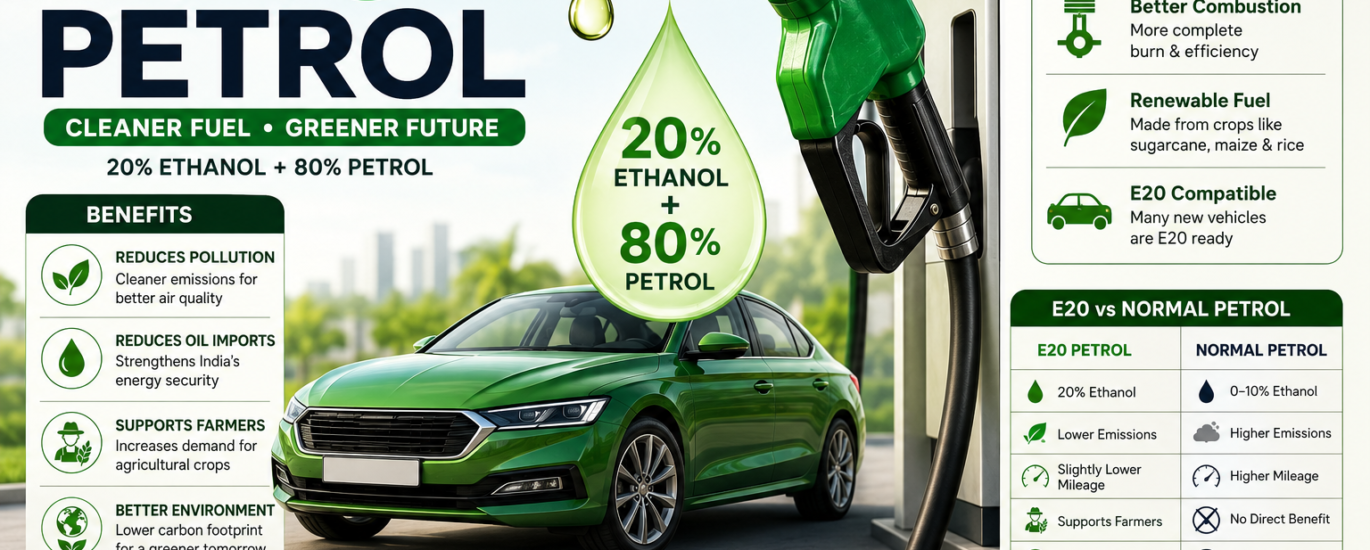
Can My Vehicle Use E20 Petrol?
This is one of the most common questions among vehicle owners.The answer depends on your vehicle’s manufacturing year, engine design, and the manufacturer’s approval. Modern vehicles are increasingly designed with fuel systems, hoses, seals, injectors, and engine components that are compatible with ethanol-blended fuels. However, older vehicles may not be fully optimized for E20.
Before using E20 petrol, always check:
- Owner’s manual
- Fuel cap sticker
- Manufacturer’s website
- Authorized service center
How to Check if Your Vehicle Supports E20 Petrol
You can verify compatibility using the following methods:
1. Owner’s Manual
Most vehicle manuals clearly mention the maximum ethanol blend supported.
Example:
✔ Suitable for E20 Fuel
or
✔ Suitable for Ethanol Blend up to 20%
2. Fuel Lid Sticker
Many new vehicles have a sticker near the fuel filler cap indicating compatibility.
3. Manufacturer Website
Most automobile manufacturers publish lists of E20-compatible models.
4. Customer Care
Contact the manufacturer’s customer support for confirmation.
Which Cars Are Generally Compatible with E20?
Many petrol cars manufactured recently are designed or updated for E20 compatibility.
Examples include newer models from brands such as:
- Maruti Suzuki
- Tata Motors
- Hyundai
- Honda
- Toyota
- Kia
- Mahindra
- Renault
- Nissan
- Volkswagen
- Skoda
Important: Compatibility varies by model and model year. Always verify with the manufacturer.
Which Bikes Support E20 Petrol?
Several motorcycle manufacturers are introducing E20-compatible models, including:
- Hero MotoCorp
- Honda Motorcycle & Scooter India
- TVS Motor
- Bajaj Auto
- Yamaha
- Royal Enfield
- Suzuki
Again, compatibility depends on the specific model and year.
Can Older Vehicles Use E20 Petrol?
Older petrol vehicles may face compatibility issues because some components were not designed for higher ethanol content.
Possible concerns include:
- Rubber hose deterioration
- Fuel seal wear
- Plastic component degradation
- Corrosion in fuel systems
- Reduced fuel efficiency
- Starting difficulties in some cases
If your vehicle is older, consult the manufacturer before regularly using E20.
Why Older Engines May Face Problems
Ethanol has different chemical properties than petrol.
It can:
- Absorb moisture from the air
- Act as a solvent, loosening deposits
- Affect certain older rubber and plastic materials
- Increase corrosion in incompatible fuel systems
Modern vehicles use ethanol-resistant materials to address these issues.
What Changes Are Made in E20-Compatible Vehicles?
Manufacturers may update:
- Fuel injectors
- Fuel pump
- Fuel tank materials
- Fuel lines
- Rubber hoses
- Engine calibration (ECU tuning)
- Pistons
- Valves
- Spark timing
- Compression settings
These changes ensure reliable performance with E20 fuel.
Does E20 Petrol Affect Mileage?
This is one of the biggest concerns among drivers.
The answer is yes, but only slightly.
Ethanol contains less energy per litre than petrol, so vehicles may experience a small reduction in fuel economy.
Typical impact:
- Around 2–7% lower mileage, depending on the vehicle, engine tuning, and driving conditions.
Modern E20-compatible engines are calibrated to minimize this difference.
Why Does Mileage Decrease?
The energy content of ethanol is lower than that of petrol.
Approximate energy values:
- Petrol: 34.2 MJ/L
- Ethanol: 21.1 MJ/L
Because E20 contains 20% ethanol, the overall energy per litre is slightly lower.
Mileage Comparison
| Fuel | Approximate Mileage |
|---|---|
| Normal Petrol | Highest |
| E10 Petrol | Slightly Lower |
| E20 Petrol | 2–7% Lower (varies by vehicle) |
Actual mileage depends on:
- Driving style
- Traffic
- Road conditions
- Vehicle maintenance
- Tyre pressure
- Engine condition
Does E20 Reduce Engine Power?
For most drivers, there is little to no noticeable difference in everyday driving.
Modern engine management systems adjust ignition timing and fuel delivery to maintain smooth performance.
Does E20 Improve Engine Performance?
Ethanol has a higher octane rating than petrol, which can offer benefits such as:
- Better resistance to engine knocking
- Improved combustion
- Smoother engine operation
However, these advantages are balanced by ethanol’s lower energy density.
Cold Starting Performance
In modern vehicles:
- Cold starts are generally unaffected because the engine control unit adjusts fuel injection.
Older vehicles without advanced engine management may experience occasional cold-start challenges.
Is Pickup Reduced?
In E20-compatible vehicles:
- Pickup remains almost the same under normal driving conditions.
Most drivers are unlikely to notice a significant difference.
Engine Noise
Many users report:
- Smoother combustion
- Reduced knocking
- Quieter engine operation
These improvements depend on the vehicle’s design and maintenance.
Advantages of E20 Petrol
1. Cleaner Fuel
E20 burns more cleanly than conventional petrol.
2. Lower Carbon Emissions
It helps reduce greenhouse gas emissions over its lifecycle.
3. Reduced Carbon Monoxide
Better combustion lowers carbon monoxide emissions.
4. Renewable Energy Source
Unlike crude oil, ethanol is produced from agricultural crops.
5. Less Dependence on Imported Oil
India imports a large share of its crude oil. Ethanol blending helps reduce this dependence.
6. Supports Farmers
Demand for ethanol creates additional markets for crops such as sugarcane and maize.
7. Encourages Rural Development
Biofuel production can generate employment and investment in rural areas.
8. Higher Octane Rating
Ethanol improves the octane value of the fuel, helping reduce engine knocking.
9. Better Combustion
The oxygen content in ethanol supports more complete combustion.
10. Strengthens Energy Security
Diversifying fuel sources makes the country less vulnerable to global oil price fluctuations.
Disadvantages of E20 Petrol
1. Slightly Lower Mileage
Because ethanol contains less energy, fuel economy may decrease slightly.
2. Compatibility Issues
Older vehicles may not be suitable for E20 without modifications.
3. Moisture Absorption
Ethanol is hygroscopic, meaning it can absorb water from the environment.
4. Material Compatibility
Some older rubber, plastic, and metal components may degrade faster.
5. Storage Challenges
Fuel stored for long periods should be handled properly to maintain quality.
6. Infrastructure Upgrades
Fuel stations, storage systems, and supply chains may require upgrades to handle higher ethanol blends efficiently.
E20 Petrol vs Normal Petrol
| Feature | E20 Petrol | Normal Petrol |
|---|---|---|
| Ethanol Content | 20% | 0–10% |
| Renewable | Yes | Mostly No |
| Pollution | Lower | Higher |
| Mileage | Slightly Lower | Higher |
| Octane Rating | Higher | Standard |
| Carbon Emissions | Lower | Higher |
| Supports Farmers | Yes | No |
| Oil Import Reduction | Yes | No |
E20 vs E10 Petrol
| Feature | E10 | E20 |
|---|---|---|
| Ethanol | 10% | 20% |
| Petrol | 90% | 80% |
| Renewable Content | Lower | Higher |
| Emission Reduction | Moderate | Greater |
| Fuel Economy | Slightly Better | Slightly Lower |
| Environmental Benefit | Good | Better |
Common Myths About E20 Petrol
Myth 1: E20 ruins every engine.
Fact: E20 is safe for vehicles designed and approved for it.
Myth 2: E20 causes immediate engine failure.
Fact: There is no evidence that approved E20 fuel causes immediate engine damage in compatible vehicles.
Myth 3: E20 dramatically reduces mileage.
Fact: The reduction is generally modest, often around 2–7%.
Myth 4: E20 is poor-quality fuel.
Fact: E20 is produced under regulated fuel quality standards.
Myth 5: E20 cannot be mixed with normal petrol.
Fact: It can be mixed, though using the recommended fuel for your vehicle is best.
Maintenance Tips for E20 Users
- Follow the manufacturer’s service schedule.
- Use fuel from reputable petrol stations.
- Replace fuel filters at recommended intervals.
- Inspect older fuel hoses and seals if your vehicle was not designed for E20.
- Avoid storing fuel for extended periods.
- Keep the fuel tank reasonably full during long storage to reduce moisture absorption.
- Monitor engine performance and consult a service center if you notice unusual behavior.
Key Takeaways
- Most newer vehicles are being designed to support E20 petrol.
- Older vehicles should use E20 only if approved by the manufacturer.
- A slight reduction in mileage is normal due to ethanol’s lower energy density.
- E20 offers cleaner combustion, reduced emissions, and supports India’s renewable energy goals.
- Proper maintenance and manufacturer guidance are essential for long-term reliability.
100 More FAQs About E20 Petrol (Part 2)
Engine & Technical FAQs
1. Does E20 petrol increase engine temperature?
No. In compatible vehicles, the engine temperature remains within the normal operating range.
2. Does E20 improve combustion efficiency?
Yes. Ethanol contains oxygen, which promotes cleaner and more complete combustion.
3. Does E20 reduce engine knocking?
Yes. Ethanol has a higher octane rating, which helps reduce knocking.
4. Can E20 cause engine misfiring?
Not in vehicles designed for E20.
5. Does E20 affect engine tuning?
Modern E20-compatible vehicles are factory-tuned for this fuel.
6. Is ECU remapping required?
No, for E20-compatible vehicles.
7. Can E20 damage spark plugs?
No.
8. Can E20 damage pistons?
No, if the engine is E20 compatible.
9. Does E20 increase engine wear?
No evidence suggests increased wear in approved engines.
10. Does E20 require premium engine oil?
No.
Fuel System FAQs
11. Can E20 damage fuel injectors?
No, in compatible vehicles.
12. Is the fuel pump affected?
Not in modern E20-ready vehicles.
13. Does ethanol clean injectors?
It can help dissolve some deposits.
14. Can E20 clog fuel filters?
Initially, ethanol may loosen old deposits in older fuel systems.
15. Does E20 evaporate faster?
Ethanol has different evaporation characteristics but is safe under normal conditions.
16. Is fuel pressure affected?
No.
17. Can E20 cause vapor lock?
Modern fuel systems are designed to minimize this risk.
18. Can E20 affect fuel lines?
Older rubber fuel lines may degrade over time.
19. Is fuel leakage possible?
Only if old seals or hoses are already damaged.
20. Should fuel hoses be replaced?
Only if recommended by the manufacturer.
Mileage FAQs
21. How much mileage loss occurs with E20?
Typically around 2–7%, depending on the vehicle.
22. Does driving style matter?
Yes.
23. Does traffic affect E20 mileage?
Yes.
24. Does highway driving improve mileage?
Yes.
25. Does AC usage affect mileage?
Yes, regardless of fuel type.
26. Does tire pressure affect E20 mileage?
Yes.
27. Does engine maintenance affect mileage?
Absolutely.
28. Can premium E20 improve mileage?
It depends on the fuel formulation.
29. Is mileage reduction permanent?
It is a characteristic of the fuel’s energy content.
30. Can proper servicing reduce mileage loss?
Good maintenance helps optimize fuel efficiency.
Cost & Pricing FAQs
31. Is E20 cheaper than petrol?
Prices depend on government policy and market conditions.
32. Will E20 reduce fuel expenses?
Not necessarily.
33. Does E20 reduce national fuel costs?
It helps reduce crude oil imports.
34. Does E20 reduce foreign exchange spending?
Yes.
35. Is ethanol expensive?
Production costs vary.
36. Does government support ethanol producers?
Various policies encourage ethanol production.
37. Can fuel prices fluctuate?
Yes.
38. Does crude oil price affect E20?
Yes.
39. Is E20 economically beneficial?
Yes, from a national perspective.
40. Can E20 stabilize fuel prices?
It can reduce dependence on imported oil.
Agriculture FAQs
41. Which crop produces the most ethanol?
Sugarcane is a major source in India.
42. Is maize used?
Yes.
43. Can rice produce ethanol?
Yes.
44. Can wheat produce ethanol?
Yes.
45. Are damaged grains used?
Yes.
46. Does E20 benefit farmers?
Yes.
47. Can agricultural waste be used?
Yes.
48. Does ethanol create rural employment?
Yes.
49. Does E20 increase crop demand?
Yes.
50. Does ethanol support the rural economy?
Yes.
Environmental FAQs
51. Does E20 reduce smoke?
Yes.
52. Does E20 reduce greenhouse gases?
It helps lower lifecycle emissions.
53. Does E20 reduce toxic emissions?
Yes.
54. Does E20 improve urban air quality?
It contributes to cleaner air.
55. Does E20 reduce particulate matter?
It can reduce certain emissions.
56. Is E20 biodegradable?
Yes.
57. Does E20 reduce fossil fuel consumption?
Yes.
58. Is ethanol carbon-neutral?
It has lower lifecycle emissions than fossil fuels, but it is not completely carbon-neutral.
59. Does E20 reduce climate impact?
It contributes to emission reduction goals.
60. Is E20 a green fuel?
Yes.
Manufacturing FAQs
61. How is ethanol made?
By fermenting sugars or starches from crops.
62. What is fermentation?
A biological process where yeast converts sugars into alcohol.
63. What is distillation?
A process used to purify ethanol.
64. Is fuel ethanol different from drinking alcohol?
Yes.
65. Is ethanol purified before blending?
Yes.
66. How is E20 produced?
By blending 20% ethanol with 80% petrol.
67. Where is blending done?
At refineries or blending facilities.
68. Who supplies ethanol?
Licensed biofuel producers.
69. Who distributes E20?
Oil marketing companies.
70. Is E20 quality-tested?
Yes.
Vehicle Maintenance FAQs
71. Do service intervals change?
Usually no.
72. Should fuel filters be inspected?
Yes.
73. Does E20 require engine flushing?
No.
74. Can E20 reduce carbon deposits?
Cleaner combustion may reduce some deposits.
75. Is injector cleaning needed?
Only during normal maintenance.
76. Can E20 affect batteries?
No.
77. Can E20 affect catalytic converters?
Compatible vehicles are designed to work with it.
78. Does E20 require different spark plugs?
No.
79. Is engine diagnostics different?
No.
80. Can E20 improve emissions test results?
It may help reduce certain pollutants.
Future FAQs
81. Will all petrol become E20?
Many regions are transitioning, but availability varies.
82. Is E20 the final fuel?
No.
83. What comes after E20?
Future options include higher ethanol blends, flex-fuel technologies, hydrogen, EVs, and other low-carbon fuels.
84. Are flex-fuel vehicles different?
Yes.
85. Can flex-fuel vehicles use E85?
Yes.
86. Can India adopt E85?
It is possible with suitable vehicles and infrastructure.
87. Is Brazil using ethanol fuel?
Yes, extensively.
88. Does the USA use ethanol blends?
Yes.
89. Will ethanol demand increase?
Yes.
90. Is biofuel the future?
Biofuels are expected to remain an important part of the global energy mix.
General FAQs
91. Is E20 safe for daily use?
Yes, in compatible vehicles.
92. Can I switch between E20 and normal petrol?
Yes.
93. Does E20 require registration changes?
No.
94. Is E20 legal?
Yes.
95. Does E20 have a different smell?
Slightly.
96. Is E20 flammable?
Yes.
97. Can E20 be exported?
Yes.
98. Is E20 available everywhere?
Availability is expanding but not universal.
99. Should I use E20 without checking compatibility?
No. Always verify your vehicle manufacturer’s recommendation.
100. Why is E20 considered important for India’s future?
Because it supports cleaner transportation, reduces oil imports, strengthens energy security, benefits farmers, and contributes to a more sustainable economy.