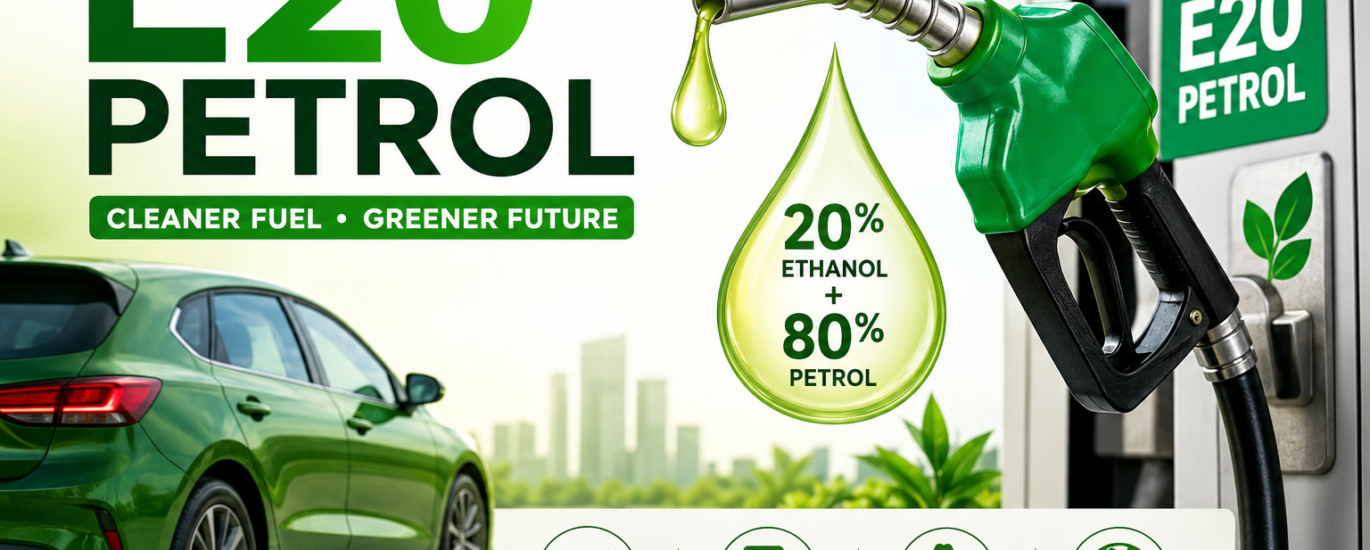
Learn everything about E20 petrol in India including its meaning, ethanol blending process, mileage, engine compatibility, environmental impact, government policies, advantages, disadvantages, FAQs, and future prospects.
E20 Petrol – The Complete Guide
The Indian automobile industry is experiencing one of its biggest fuel transitions in decades. After the successful adoption of BS6 emission standards, India is now promoting E20 petrol, a cleaner and more sustainable alternative to conventional petrol. This initiative is expected to reduce dependence on imported crude oil, support farmers, lower harmful emissions, and create a greener transportation ecosystem.
If you’ve visited a petrol pump recently, you may have noticed signs displaying “E20 Petrol Available Here.” This has raised many questions among vehicle owners:
- What exactly is E20 petrol?
- Can I use E20 in my bike or car?
- Will it reduce mileage?
- Is it safe for older vehicles?
- Does E20 damage engines?
- Why is the Government promoting E20?
This comprehensive guide answers every important question in detail.
What is E20 Petrol?
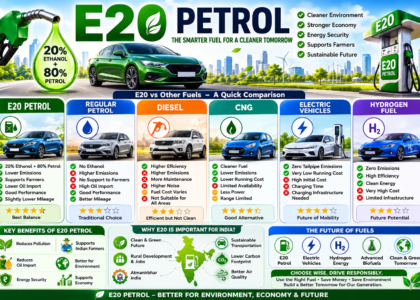
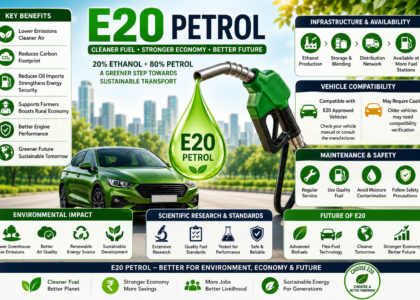
E20 petrol is a type of fuel that contains:
- 20% Ethanol
- 80% Petrol (Gasoline)
The letter “E” stands for Ethanol, while the number 20 represents the percentage of ethanol mixed with petrol.
In simple words:
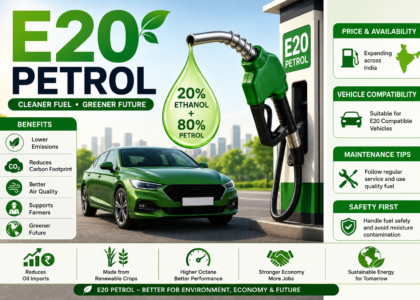
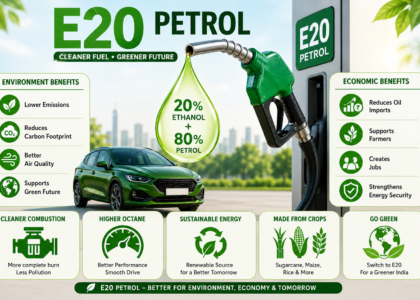
E20 Petrol = 20% Ethanol + 80% Petrol
Unlike pure petrol, E20 is a blended fuel designed to reduce pollution and dependence on fossil fuels.
What is Ethanol?
Ethanol is a renewable, biodegradable, alcohol-based fuel produced mainly from agricultural crops.
Common sources include:
- Sugarcane
- Sugarcane molasses
- Corn (Maize)
- Rice
- Wheat
- Damaged food grains
- Sweet sorghum
- Cassava
- Agricultural biomass
Unlike crude oil, ethanol is produced every year through agriculture, making it a renewable source of energy.
Chemical Formula of Ethanol
Chemical Name:
Ethyl Alcohol
Chemical Formula:
C₂H₅OH
Molecular Weight:
46.07 g/mol
Appearance:
- Colorless
- Transparent liquid
- Slight alcoholic smell
Why is Ethanol Mixed with Petrol?
There are several important reasons.
1. Reduce Crude Oil Imports
India imports nearly 85% of its crude oil requirement, making the country vulnerable to global oil price fluctuations.
By blending ethanol with petrol:
- Less crude oil is needed.
- Foreign exchange is saved.
- Energy security improves.
2. Reduce Pollution
Burning petrol releases:
- Carbon monoxide (CO)
- Carbon dioxide (CO₂)
- Hydrocarbons (HC)
- Nitrogen oxides (NOx)
- Particulate matter
Ethanol contains oxygen, which helps fuel burn more completely, reducing several harmful emissions.
3. Support Farmers
India produces millions of tonnes of sugarcane, maize, and other crops every year.
Instead of allowing excess production to go to waste, these crops can be converted into ethanol, providing:
- Better income for farmers
- Stable agricultural demand
- Rural employment
- Growth of biofuel industries
4. Reduce Greenhouse Gas Emissions
Ethanol is considered a cleaner fuel because the carbon released during combustion is partially offset by the carbon absorbed by crops during their growth.
This helps reduce the overall carbon footprint.
What Does E20 Mean?
Fuel blends are named according to the percentage of ethanol they contain.
| Fuel Type | Ethanol | Petrol |
|---|---|---|
| E5 | 5% | 95% |
| E10 | 10% | 90% |
| E15 | 15% | 85% |
| E20 | 20% | 80% |
| E85 | 85% | 15% |
| E100 | 100% | 0% |
India previously used E10 in most regions and is gradually transitioning toward E20.
History of Ethanol Blending in India
India’s ethanol blending journey began more than two decades ago.
Timeline
2001
The Government initiated ethanol blending on a pilot basis.
2003
The Ethanol Blended Petrol (EBP) Programme was officially launched.
2006
Several states adopted 5% ethanol blending.
2013
Blending expanded to more regions.
2018
The National Biofuel Policy accelerated ethanol production.
2021
India announced an ambitious target to achieve 20% ethanol blending.
2023–2025
Oil companies rapidly expanded E20 availability across the country.
2026
E20 petrol is becoming increasingly available at fuel stations, while automobile manufacturers continue introducing E20-compatible vehicles.
Why Did India Choose E20 Instead of Higher Blends?
There are several practical reasons:
- Most modern petrol engines can be adapted to E20 with relatively minor modifications.
- Existing fuel infrastructure requires limited changes.
- Higher blends such as E85 or E100 need specially designed flex-fuel engines.
- E20 strikes a balance between reducing emissions and maintaining vehicle compatibility.
How is Ethanol Produced?
The production process involves fermentation and distillation.
Step 1: Raw Material Collection
Raw materials include:
- Sugarcane juice
- Molasses
- Corn
- Rice
- Wheat
- Agricultural waste
Step 2: Grinding
The crops are crushed to extract sugars or starch.
Step 3: Fermentation
Yeast is added to convert sugars into alcohol.
This process typically takes 40–72 hours.
Step 4: Distillation
The fermented liquid is heated to separate ethanol from water and impurities.
Step 5: Dehydration
Water is removed to produce fuel-grade ethanol.
Step 6: Blending
The ethanol is transported to refineries, where it is blended with petrol to create E20 fuel.
Properties of E20 Petrol
| Property | E20 Petrol |
|---|---|
| Colour | Light Yellow / Clear |
| Octane Rating | Higher than normal petrol |
| Renewable | Yes |
| Oxygen Content | Higher |
| Sulphur | Lower |
| Carbon Emissions | Lower |
| Biodegradable | Yes |
| Renewable Source | Yes |
How Does E20 Work Inside an Engine?
The combustion process is almost identical to conventional petrol.
When E20 enters the combustion chamber:
- Air mixes with the fuel.
- The spark plug ignites the mixture.
- Ethanol supplies additional oxygen.
- Fuel burns more completely.
- The engine generates power.
- Harmful emissions are reduced.
Because ethanol has a higher octane rating than petrol, it can improve combustion quality. However, ethanol also contains less energy per litre than petrol, which may slightly reduce fuel economy in some vehicles.
What Makes Ethanol Different from Petrol?
| Feature | Petrol | Ethanol |
|---|---|---|
| Source | Crude Oil | Agricultural Crops |
| Renewable | No | Yes |
| Oxygen Content | Low | High |
| Octane Rating | Good | Very High |
| Carbon Emissions | Higher | Lower |
| Energy Density | Higher | Lower |
| Biodegradable | No | Yes |
What is the Ethanol Blended Petrol (EBP) Programme?
The Ethanol Blended Petrol Programme is a Government initiative aimed at increasing the percentage of ethanol mixed with petrol sold across India.
Its major objectives include:
- Reducing oil imports
- Supporting Indian farmers
- Lowering air pollution
- Improving energy security
- Promoting renewable fuels
- Strengthening the rural economy
Oil Marketing Companies purchase ethanol from domestic producers and blend it with petrol before supplying it to fuel stations.
Objectives of the E20 Mission
The E20 programme is designed to achieve multiple national goals:
- Reduce dependence on imported fossil fuels.
- Improve air quality.
- Cut greenhouse gas emissions.
- Increase farmers’ income.
- Encourage biofuel production.
- Promote sustainable transportation.
- Boost the rural economy.
- Strengthen India’s energy independence.
Key Takeaways
- E20 petrol contains 20% ethanol and 80% petrol.
- Ethanol is a renewable fuel made from crops such as sugarcane, maize, rice, and wheat.
- E20 helps reduce emissions and crude oil imports.
- The programme supports farmers and promotes sustainable energy.
- While E20 has environmental and economic benefits, vehicle compatibility and fuel efficiency are important considerations that drivers should understand.
100 Frequently Asked Questions (FAQs) About E20 Petrol (2026 Guide)
General Questions
1. What is E20 petrol?
E20 petrol is a fuel blend containing 20% ethanol and 80% petrol.
2. What does E20 stand for?
“E” stands for ethanol, and “20” indicates a 20% ethanol blend.
3. What is ethanol?
Ethanol is a renewable alcohol-based fuel produced from crops like sugarcane, maize, rice, and wheat.
4. Is E20 petrol available in India?
Yes, E20 petrol is gradually becoming available across India.
5. Why is E20 introduced?
To reduce crude oil imports, lower emissions, and promote renewable energy.
6. Is E20 petrol compulsory?
It depends on government rollout and fuel station availability.
7. Is E20 eco-friendly?
Yes, it is considered more environmentally friendly than conventional petrol.
8. What color is E20 petrol?
It looks similar to normal petrol.
9. Is ethanol renewable?
Yes.
10. Is E20 a biofuel?
Yes.
Vehicle Compatibility
11. Can all cars use E20 petrol?
No. Only E20-compatible vehicles are fully recommended.
12. Can bikes use E20?
Modern E20-compatible bikes can.
13. Can scooters use E20?
Yes, if approved by the manufacturer.
14. Will E20 damage old engines?
Older vehicles may experience compatibility issues if not designed for E20.
15. Which vehicles support E20?
Most newly launched petrol vehicles designed for E20 compatibility.
16. Can BS6 vehicles use E20?
Many newer BS6 vehicles are compatible, but always check the owner’s manual.
17. Can motorcycles use E20?
Yes, if manufacturer-approved.
18. Can generators use E20?
Only if approved by the manufacturer.
19. Can lawn equipment use E20?
Not always.
20. Can boats use E20?
Only engines designed for ethanol blends.
Mileage & Performance
21. Does E20 reduce mileage?
A slight reduction in fuel economy may occur because ethanol contains less energy than petrol.
22. Is pickup affected?
Usually very little in compatible engines.
23. Does E20 increase power?
Not significantly in standard engines.
24. Does E20 improve combustion?
Yes.
25. Does E20 reduce knocking?
Higher octane can help reduce engine knocking.
26. Is acceleration affected?
Generally minimal in compatible vehicles.
27. Does E20 start easily?
Yes.
28. Is cold starting affected?
Modern vehicles compensate effectively.
29. Is highway performance different?
Usually not noticeable.
30. Is city driving affected?
No major difference for compatible vehicles.
Engine Safety
31. Is E20 safe?
Yes, for compatible engines.
32. Does E20 corrode metal?
It can affect certain older materials not designed for ethanol.
33. Does it damage rubber parts?
Older rubber components may degrade faster.
34. Does it damage fuel pumps?
Not in E20-compatible vehicles.
35. Does it clog injectors?
No, when using quality fuel and proper maintenance.
36. Does E20 clean engines?
It can help reduce some deposits.
37. Is engine oil affected?
Normal maintenance intervals should be followed.
38. Can E20 mix with normal petrol?
Yes.
39. Can I switch back to normal petrol?
Yes.
40. Does E20 reduce engine life?
Not in engines designed for E20.
Environment
41. Is E20 better for the environment?
Yes.
42. Does it reduce pollution?
Yes.
43. Does it reduce CO₂ emissions?
It helps lower lifecycle greenhouse gas emissions.
44. Does E20 reduce carbon monoxide?
Yes.
45. Does it improve air quality?
It can contribute to cleaner air.
46. Is ethanol biodegradable?
Yes.
47. Does E20 support green energy?
Yes.
48. Does E20 reduce fossil fuel use?
Yes.
49. Can E20 fight climate change?
It can contribute as part of broader emission reduction efforts.
50. Is E20 sustainable?
Yes, when produced responsibly.
Government & Economy
51. Why is the Indian government promoting E20?
To improve energy security and support sustainable transport.
52. Does E20 reduce oil imports?
Yes.
53. Does E20 help farmers?
Yes.
54. Which crops produce ethanol?
Sugarcane, maize, rice, wheat, and others.
55. Is ethanol made in India?
Yes.
56. Who manufactures ethanol?
Licensed distilleries and biofuel producers.
57. Is E20 subsidized?
Policies vary over time.
58. Will E20 replace petrol?
It is a blended form of petrol, not a complete replacement.
59. Does E20 create jobs?
Yes, particularly in agriculture and biofuel industries.
60. Does E20 support rural development?
Yes.
Fuel Quality
61. Is E20 better than E10?
It contains more renewable ethanol.
62. Is E20 better than normal petrol?
It offers environmental benefits, though mileage may be slightly lower.
63. What is the octane rating?
Generally higher than regular petrol.
64. Does E20 burn cleaner?
Yes.
65. Does E20 absorb water?
Ethanol is hygroscopic and can absorb moisture.
66. Can E20 expire?
Fuel quality can degrade over long storage periods.
67. Can E20 be stored?
Yes, using proper fuel storage practices.
68. Is E20 flammable?
Yes.
69. Does E20 smell different?
It may have a slightly different odor.
70. Is E20 transparent?
Yes.
Maintenance
71. Do I need special servicing?
No, follow manufacturer recommendations.
72. Should fuel filters be changed?
At the recommended service interval.
73. Should spark plugs be replaced early?
Only if required by maintenance schedules.
74. Can E20 cause rust?
Moisture contamination can increase corrosion risks in unsuitable systems.
75. Is premium servicing required?
No.
76. Can E20 affect fuel hoses?
Older hoses may be more vulnerable.
77. Should I check seals?
Yes, especially in older vehicles.
78. Can E20 damage plastic tanks?
Compatible vehicles use ethanol-resistant materials.
79. Does E20 require additives?
Usually not.
80. Can I use fuel stabilizers?
If storing fuel for long periods, consult product guidance.
Future of E20
81. Will E20 become common?
Yes.
82. Is E20 India’s future fuel?
It is an important part of India’s fuel strategy.
83. Will more stations offer E20?
Yes.
84. Can E20 replace diesel?
No.
85. Will E20 replace EVs?
No.
86. Is flex-fuel different?
Yes.
87. What is E85?
A fuel containing 85% ethanol.
88. What is E100?
Pure ethanol fuel.
89. Which countries use ethanol fuel?
Countries including Brazil and the United States use high ethanol blends.
90. Will ethanol production increase?
Yes, demand is expected to grow.
Miscellaneous
91. Is E20 expensive?
Pricing depends on market and government policies.
92. Can E20 improve fuel quality?
It increases the renewable content of the fuel.
93. Is E20 tested?
Yes.
94. Who approves E20?
Fuel standards are regulated by relevant government authorities.
95. Can I mix E20 with premium petrol?
Yes, but follow manufacturer recommendations.
96. Does E20 increase maintenance cost?
Generally not for compatible vehicles.
97. Is E20 safe during summer?
Yes.
98. Is E20 safe during winter?
Yes.
99. Should I worry about using E20?
If your vehicle is approved for E20, there is generally no reason for concern.
100. Is E20 the future of cleaner transportation in India?
E20 is expected to play a major role in reducing emissions, supporting farmers, improving energy security, and making India’s transport sector more sustainable.