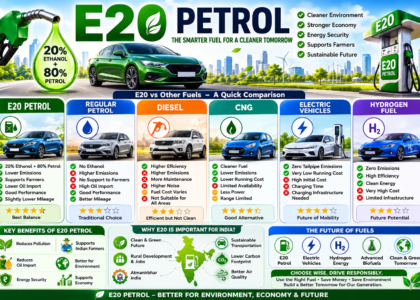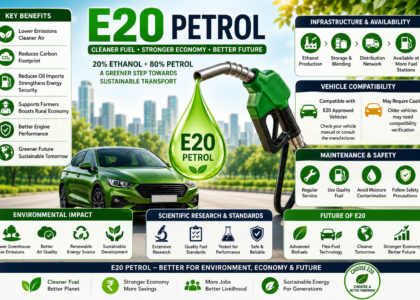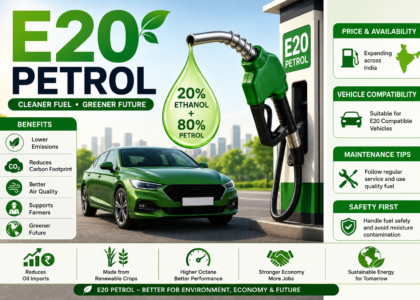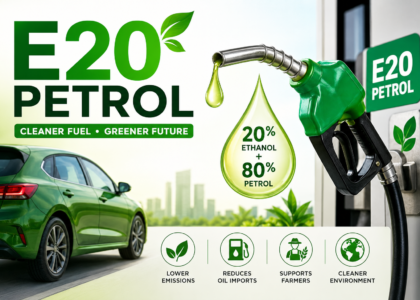
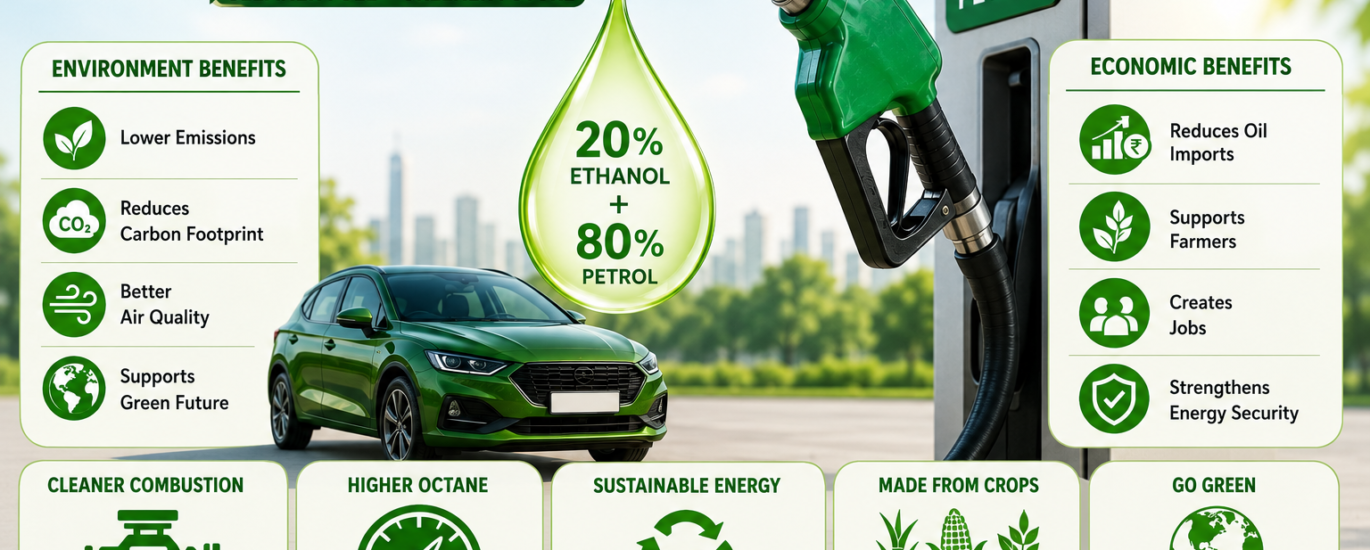
Environmental Impact of E20 Petrol
The introduction of E20 Fuel is not only an important step toward reducing India’s dependence on imported crude oil but also a significant move to improve environmental sustainability. By blending ethanol—a renewable, plant-based fuel—with petrol, E20 helps lower harmful emissions and supports cleaner transportation.
As concerns about climate change and air pollution continue to grow, ethanol-blended fuels are becoming an important part of the global transition to cleaner energy.
How E20 Fuel Helps Protect the Environment – E20 Petrol
E20 petrol offers several environmental advantages compared to conventional petrol.
These include:
- Lower greenhouse gas emissions
- Cleaner combustion
- Reduced carbon monoxide emissions
- Lower hydrocarbon emissions
- Reduced dependence on fossil fuels
- Increased use of renewable energy
- Better air quality in urban areas
Reduction in Carbon Dioxide (CO₂) Emissions
One of the primary goals of E20 petrol is reducing carbon dioxide emissions.
Traditional petrol is produced entirely from crude oil. When burned, it releases carbon that has been stored underground for millions of years, contributing to climate change.
Ethanol, on the other hand, is produced from crops. During their growth, these crops absorb carbon dioxide from the atmosphere through photosynthesis.
This creates a more balanced carbon cycle compared with fossil fuels, resulting in lower lifecycle greenhouse gas emissions.
Cleaner Combustion
Ethanol contains oxygen in its molecular structure.
This additional oxygen promotes more complete combustion inside the engine, reducing the formation of harmful pollutants.
Cleaner combustion can help reduce:
- Carbon monoxide (CO)
- Unburned hydrocarbons (HC)
- Certain particulate emissions
Improved Air Quality
Air pollution remains a major challenge in many cities.
Vehicle emissions contribute significantly to:
- Smog
- Respiratory illnesses
- Reduced visibility
- Environmental degradation
By promoting cleaner combustion, E20 petrol can contribute to improved air quality when used in compatible vehicles.
Reduced Dependence on Fossil Fuels
Petrol is derived from crude oil, a finite natural resource.
Ethanol is renewable because it is produced from agricultural crops that can be grown and harvested each year.
Using E20 petrol increases the share of renewable energy in the transport sector.
Renewable Energy Contribution
Renewable fuels are essential for achieving long-term sustainability.
Benefits include:
- Lower carbon footprint
- Energy diversification
- Reduced fossil fuel consumption
- Sustainable agricultural development
How E20 Supports India’s Climate Goals
India has committed to reducing emissions and increasing the use of renewable energy.
The E20 programme supports these objectives by:
- Lowering lifecycle greenhouse gas emissions
- Encouraging cleaner transport
- Promoting biofuel production
- Supporting sustainable development
Economic Benefits of E20 Petrol
Beyond environmental advantages, E20 also offers significant economic benefits.
Reduced Crude Oil Imports
India imports a large share of its crude oil requirements.
High crude oil imports affect:
- Foreign exchange reserves
- Fuel prices
- Trade balance
- Energy security
Increasing ethanol blending reduces the need for imported petrol components.
Saving Foreign Exchange
Reducing oil imports means India can save valuable foreign currency that would otherwise be spent on crude oil purchases.
These savings can support:
- Infrastructure
- Education
- Healthcare
- Renewable energy investments
Boost to Farmers
The ethanol industry creates additional demand for agricultural products such as:
- Sugarcane
- Maize
- Rice
- Wheat
- Damaged food grains
This provides farmers with additional income opportunities and helps stabilize agricultural markets.
Growth of Rural Economy
Ethanol production encourages investment in:
- Rural industries
- Distilleries
- Storage facilities
- Transportation
- Agricultural processing
These developments create employment and improve local economies.
Job Creation
The ethanol ecosystem generates jobs across multiple sectors:
- Agriculture
- Manufacturing
- Transportation
- Logistics
- Engineering
- Research
- Biofuel production
Strengthening Energy Security
Countries that depend heavily on imported fuel are vulnerable to:
- Global oil price fluctuations
- Supply disruptions
- Geopolitical tensions
Producing ethanol domestically helps diversify India’s energy sources and strengthens long-term energy security.
Government Initiatives Supporting E20
The Government of India has launched several initiatives to promote ethanol blending.
Key objectives include:
- Increasing ethanol production capacity
- Supporting biofuel industries
- Expanding blending infrastructure
- Encouraging E20-compatible vehicle manufacturing
- Promoting sustainable transportation
National Policy on Biofuels
India’s biofuel policy encourages:
- Production of ethanol from multiple feedstocks
- Efficient use of agricultural resources
- Investment in biofuel technology
- Reduction of fossil fuel dependence
Ethanol Blended Petrol Programme (EBP)
The Ethanol Blended Petrol Programme aims to:
- Increase ethanol blending across the country
- Improve fuel quality
- Reduce emissions
- Support domestic agriculture
- Strengthen energy independence
Infrastructure Development
To support E20 adoption, investments are being made in:
- Ethanol production plants
- Storage terminals
- Fuel blending facilities
- Distribution networks
- Petrol station upgrades
Automobile Industry Response
Vehicle manufacturers are redesigning engines and fuel systems to ensure compatibility with E20.
Key improvements include:
- Ethanol-resistant fuel lines
- Improved fuel pumps
- Updated engine calibration
- Compatible injectors
- Enhanced ECU programming
Scientific Research on E20
Extensive research has evaluated the impact of ethanol blends on engine performance and emissions.
Studies generally indicate that, in compatible vehicles:
- Combustion becomes cleaner.
- Carbon monoxide emissions decrease.
- Engine knocking is reduced due to ethanol’s higher octane rating.
- Fuel economy may decrease slightly because ethanol contains less energy per litre.
Actual results vary depending on the vehicle design and operating conditions.
Global Adoption of Ethanol-Blended Fuels
Many countries already use ethanol-blended fuels.
Brazil
Brazil is one of the world’s largest ethanol users.
Key features:
- Extensive sugarcane-based ethanol production
- Wide availability of flex-fuel vehicles
- Long history of ethanol use
United States
The United States produces ethanol primarily from corn.
Common fuel blends include:
- E10
- E15
- E85 (for flex-fuel vehicles)
Canada
Canada promotes renewable fuel blending through provincial and federal policies.
Thailand
Thailand has expanded ethanol use to reduce imported fuel dependence.
European Countries
Several European nations encourage biofuel blending to reduce emissions and meet climate targets.
Why Countries Prefer Ethanol Blending
Major reasons include:
- Cleaner fuel
- Lower emissions
- Renewable energy
- Reduced oil imports
- Agricultural development
- Better energy security
Challenges of E20 Adoption
Although E20 offers many benefits, implementation also involves challenges.
These include:
- Upgrading older vehicles
- Expanding fuel infrastructure
- Increasing ethanol production
- Managing feedstock availability
- Maintaining fuel quality standards
- Consumer awareness
Future of E20 Petrol
The future of E20 depends on continued cooperation among:
- Government
- Automobile manufacturers
- Fuel companies
- Farmers
- Researchers
- Consumers
As technology advances, ethanol blending is expected to become more efficient and sustainable.
Beyond E20
Future transportation may include:
- Higher ethanol blends (where appropriate)
- Flex-fuel vehicles
- Electric vehicles (EVs)
- Hydrogen fuel-cell vehicles
- Sustainable aviation fuels
- Advanced biofuels
Rather than replacing these technologies, E20 is expected to complement them during the transition to lower-carbon mobility.
Key Takeaways
- E20 petrol helps reduce emissions and supports cleaner transportation.
- Ethanol is a renewable fuel produced from agricultural crops.
- The E20 programme strengthens India’s energy security and reduces crude oil imports.
- Farmers benefit through increased demand for ethanol feedstocks.
- Global experience shows ethanol blending can play an important role in sustainable transportation.
- Continued investment in infrastructure, technology, and consumer awareness will be essential for the long-term success of E20.
50 More E20 Petrol FAQs (Part 3) – FAQ 201 to 250
Fuel Composition & Science
201. What is the ethanol percentage in E20 petrol?
E20 petrol contains 20% ethanol and 80% petrol.
202. Is ethanol an alcohol?
Yes. Ethanol is a type of alcohol used as a renewable fuel.
203. What is fuel-grade ethanol?
Fuel-grade ethanol is highly purified ethanol specifically produced for blending with petrol.
204. Is ethanol colorless?
Yes.
205. Is ethanol biodegradable?
Yes.
206. Does ethanol contain oxygen?
Yes, which helps improve combustion.
207. Why is oxygen important in ethanol?
It promotes cleaner and more complete fuel burning.
208. Does E20 burn faster than petrol?
Its combustion characteristics differ, but engines are calibrated to use it efficiently.
209. Is E20 a renewable fuel?
Yes.
210. Can ethanol be produced every year?
Yes, because it comes from agricultural crops.
Fuel Quality
211. Does E20 improve fuel quality?
It increases the renewable content and octane rating of petrol.
212. Does E20 reduce fuel impurities?
Fuel quality depends on refining and blending standards.
213. Is E20 tested before sale?
Yes.
214. Who checks fuel quality?
Authorized fuel companies and regulatory agencies.
215. Can contaminated E20 damage engines?
Yes. Like any contaminated fuel, it can cause engine problems.
216. How can I identify quality fuel?
Purchase fuel from trusted petrol stations.
217. Can E20 become contaminated?
Yes, if stored improperly.
218. Does E20 have water tolerance?
Ethanol can absorb moisture, so proper storage is important.
219. Is E20 safe after long storage?
It is best used within recommended storage periods.
220. Does E20 require special storage tanks?
Commercial storage systems are designed to meet required standards.
Engine Performance
221. Does E20 improve throttle response?
Modern E20-compatible vehicles generally maintain normal throttle response.
222. Can E20 improve engine smoothness?
Some drivers notice smoother combustion.
223. Does E20 reduce vibration?
Engine condition plays a larger role than fuel type.
224. Does E20 improve idle quality?
Compatible engines usually idle normally.
225. Can E20 affect turbocharged engines?
Only if approved by the manufacturer.
226. Does E20 improve combustion efficiency?
Yes.
227. Does E20 produce less smoke?
Yes, compared with conventional petrol.
228. Can E20 increase exhaust temperature?
Modern engines are designed to manage normal operating temperatures.
229. Is E20 suitable for long-distance travel?
Yes, in approved vehicles.
230. Can E20 be used every day?
Yes.
Maintenance
231. Should I inspect my fuel tank regularly?
Routine maintenance is always recommended.
232. Does E20 require fuel additives?
Usually not.
233. Can injector cleaners still be used?
Follow your vehicle manufacturer’s recommendations.
234. Does E20 affect air filters?
No.
235. Does E20 affect engine coolant?
No.
236. Does E20 require different spark timing?
Compatible vehicles are already calibrated.
237. Should I replace old fuel hoses?
If your vehicle is older and not designed for ethanol blends, inspection is advisable.
238. Does E20 increase maintenance frequency?
No.
239. Should I service my vehicle more often?
Follow the normal service schedule.
240. Can E20 improve engine cleanliness?
Cleaner combustion may help reduce certain deposits.
Government & Future
241. Why is India promoting ethanol blending?
To improve energy security, support farmers, and reduce emissions.
242. Does E20 reduce India’s oil imports?
Yes.
243. Is ethanol production increasing?
Yes.
244. Will more ethanol plants be built?
Production capacity is expected to expand.
245. Does E20 create employment?
Yes.
246. Can E20 support economic growth?
Yes.
247. Is E20 part of India’s green energy strategy?
Yes.
248. Will future vehicles be E20 compatible?
Many new petrol vehicles are being designed for E20 compatibility.
249. Is E20 an alternative to fossil fuels?
It is a blended fuel that reduces reliance on fossil fuels.
250. Why is E20 considered an important step toward sustainable transportation?
Because it combines renewable ethanol with petrol to reduce emissions, support agriculture, strengthen energy security, and promote a cleaner transport system.