


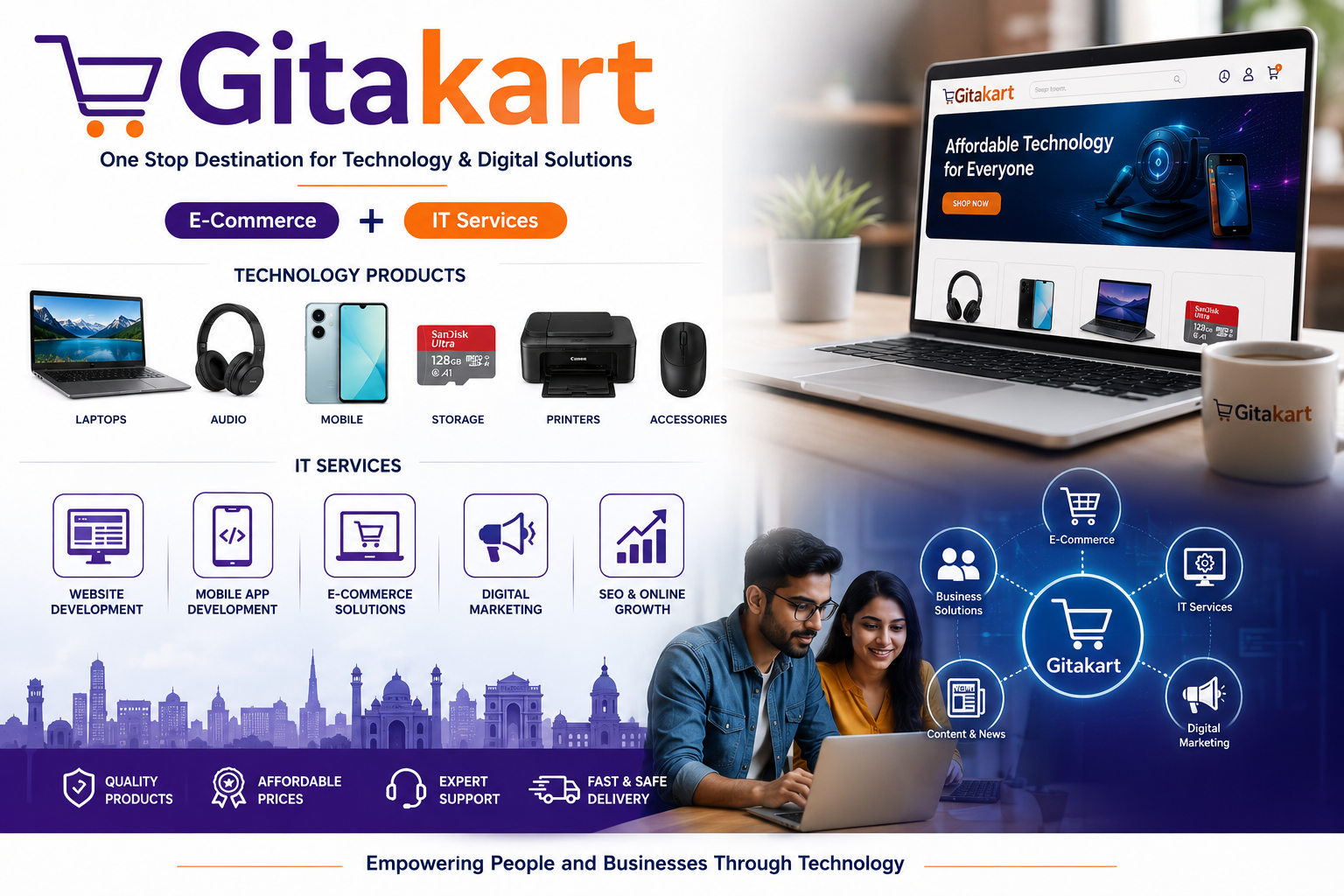
Gitakart Case Study: The Indian digital economy has changed dramatically over the last decade. The internet is no longer simply a place where people search for information. It has become a marketplace, communication network, service platform, advertising channel, education system, entertainment ecosystem and business infrastructure.
For entrepreneurs, this transformation has created enormous opportunities.
A small company can now sell products across India without maintaining hundreds of physical stores. A local technology company can provide services to customers in different cities. A website can become a storefront that remains open twenty-four hours a day.
Gitakart is an interesting example of this new type of Indian digital business.
Gitakart operates at the intersection of e-commerce, technology products, website development, mobile application development, digital marketing and IT services. Its public website describes the company as a destination for affordable technology products and IT services, while its product catalogue includes electronics, accessories, storage devices, mobile phones, smart devices and other consumer products. (GITAKART)
The company also presents itself as part of a wider digital-business ecosystem that includes other ventures such as Hathua Samachar and Kallmagic, according to its public About Us page. (GITAKART)
This makes Gitakart more interesting than a conventional online shop.
It can be studied as an example of:
The most interesting question is therefore not simply:
“What does Gitakart sell?”
The deeper question is:
“How can an Indian entrepreneur build a sustainable digital business by combining e-commerce, technology services, content, software and local business capabilities?”
This article explores that question in detail.
Gitakart is an Indian digital-commerce and IT-services brand.
Its public website describes Gitakart as a one-stop destination for technology products and IT services, with offerings including:
The company states that its objective is to make technology accessible and affordable while helping businesses participate in the digital economy. (GITAKART)
Its e-commerce website also carries consumer electronics and accessories, including products such as Bluetooth audio devices, storage cards, mobile phones and other technology products. (GITAKART)
Therefore, Gitakart can be viewed as having two major sides:
Selling physical products online.
Providing digital and IT-related services.
This combination creates a broader business model than a traditional online retailer.
At its simplest, Gitakart connects:
with
and
But the model can be expanded further.
Gitakart operates across several interconnected areas:
IT Products
↓
E-Commerce
↓
Website Development
↓
Mobile App Development
↓
Digital Marketing
↓
Content & SEO
↓
Digital Business Ecosystem
This creates multiple potential revenue channels.
Small businesses and individual customers often face several problems.
A customer may need:
A business may need:
Traditionally, the customer might need to contact different companies for each requirement.
Gitakart’s model attempts to bring multiple technology requirements under one digital brand.
Imagine a small business owner.
First, they need:
Later:
Then:
Then:
Then:
Then:
Instead of acquiring each service from a completely unrelated provider, a technology-focused ecosystem can potentially serve multiple requirements.
This creates an important business concept:
Customer Lifetime Value, or CLV, represents the economic value a customer generates over the entire relationship with a business.
For example:
A customer who buys a ₹500 accessory once is valuable.
But a business customer who purchases:
over several years can be much more valuable.
This is one reason why combining products and services can be strategically attractive.
Gitakart’s public About Us page describes the company as more than an e-commerce platform and identifies other ventures within its wider business family, including Hathua Samachar and Kallmagic. (GITAKART)
This suggests an ecosystem approach.
A simplified model can be represented as:
Gitakart
├── E-Commerce
├── IT Products
├── Website Development
├── Mobile App Development
├── Digital Marketing
├── Hathua Samachar
└── Kallmagic
The significance of this model is that different businesses can potentially generate traffic, customers and data for one another.
One of the most interesting aspects of Gitakart is the relationship between local entrepreneurship and digital commerce.
The company identifies with Durgapur, West Bengal, while its website positions the business for broader digital accessibility. Its public company information lists a Durgapur location and contact details. (GITAKART)
This represents a larger trend in India:
A company no longer needs to depend exclusively on customers who physically walk into a shop.
Durgapur is an important industrial and commercial city in West Bengal.
For a technology company, operating from a city like Durgapur can create several advantages:
At the same time, digital infrastructure allows the company to serve customers beyond the immediate city.
This creates a powerful combination:
The local presence can build:
The online presence can create:
This hybrid model is particularly relevant for Indian small and medium businesses.
India’s e-commerce market has grown dramatically.
Customers increasingly expect:
A company operating in technology products therefore has a natural reason to build an online store.
Gitakart’s website follows a conventional e-commerce structure.
The public storefront includes:
The site currently displays products including Bluetooth audio devices, storage cards, feature phones and other technology products. (GITAKART)
This creates the foundation for an online retail business.
The product ecosystem includes technology-oriented products such as:
The About Us page specifically identifies laptops, desktops, printers and hard drives among its IT-product offerings. (GITAKART)
Gitakart’s public messaging emphasizes affordability and accessibility.
This is strategically important in India.
The Indian market contains customers with very different budgets.
A successful technology retailer can serve:
Not every customer wants the most expensive product.
Many customers ask:
“What is the best product for my budget?”
This creates an opportunity for a retailer to compete through:
Gitakart’s current storefront displays products with significant promotional discounts on some listings. (GITAKART)
Discounts can increase:
But excessive discounting can also create problems.
If every competitor offers:
“Lowest price.”
the market becomes a race to the bottom.
A sustainable e-commerce business needs additional advantages such as:
One potential differentiator is that Gitakart is not only a product seller.
Its website also presents services such as:
(GITAKART)
This can create a significant advantage.
Consider a small company.
It purchases:
from Gitakart.
Then it needs:
Gitakart can potentially provide it.
Then:
Again, the same business can potentially serve the customer.
This is a cross-selling opportunity.
Cross-selling means selling additional products or services to an existing customer.
For example:
↓
Offer:
↓
Offer:
↓
Offer:
↓
Offer:
This can increase customer lifetime value.
Upselling means encouraging customers to choose a higher-value version.
For example:
versus
Or:
versus
Upselling can increase average order value.
Average Order Value, or AOV, is an important e-commerce metric.
A business can increase AOV through:
For technology products, bundling can be particularly effective.
A customer buying a laptop might also need:
Instead of selling one product, the business can sell:
This improves convenience and can increase revenue per customer.
Gitakart can potentially serve two major customer segments.
Business to Consumer.
Examples:
Business to Business.
Examples:
B2B customers can be particularly valuable because they may purchase repeatedly.
A business may need:
A technology company can potentially become a recurring supplier.
This creates:
The IT-services side may ultimately offer higher margins than commodity product sales.
Physical products can have:
Services can have different economics.
A website or software project may primarily require:
This makes services an important part of the overall business model.
Gitakart publicly describes website development as one of its services. (GITAKART)
Website development can range from:
to
to
to
This gives the business opportunities across different price points.
Mobile apps can provide another revenue channel.
Businesses increasingly use apps for:
Gitakart’s public materials identify mobile application development among its technology services. (GITAKART)
This is particularly interesting.
Gitakart does not only operate an e-commerce website.
Its public About Us page also lists e-commerce solutions as a service. (GITAKART)
Therefore, Gitakart can potentially operate on both sides of the market:
and
Digital marketing is another major service area.
Businesses need:
Providing these services can create recurring relationships.
Search Engine Optimization can help Gitakart acquire visitors searching for:
This creates an important opportunity:
Gitakart maintains an active article section.
Its website currently includes technology, business, marketing and educational content, including articles about topics such as laptops, local search, Li-Fi and other technology subjects. (GITAKART)
This is more than publishing random articles.
Content can become a customer-acquisition channel.
The model can be:
Publish Content
↓
Rank in Search Engines
↓
Receive Organic Traffic
↓
Build Brand Awareness
↓
Promote Products
↓
Generate Leads
↓
Generate Sales
↓
Publish More Content
This creates a digital growth flywheel.
A customer may search:
“Best laptop under ₹30,000.”
This is informational.
Gitakart can publish an article answering the question.
That visitor may then discover:
This creates a transition from:
Other searches are closer to purchase intent:
These searches can produce direct sales opportunities.
This is one of the strongest opportunities for Gitakart.
A content article can recommend a product.
A product page can link back to educational content.
This creates a loop:
Article
↔
Product
↔
Customer
↔
Purchase
If a website consistently publishes content around:
search engines may increasingly understand the site’s topical relevance.
This can support long-term SEO.
A product page is not simply a place to display a price.
A strong product page should answer:
Good product information reduces uncertainty.
E-commerce is fundamentally a trust business.
Customers need confidence that:
Gitakart publishes policies for areas such as exchange, returns and shipping. Its current exchange policy describes a seven-day exchange window subject to eligibility conditions. (GITAKART)
Technology products can sometimes arrive:
A clearly defined exchange process reduces customer anxiety.
Gitakart’s published policy says eligible products can be exchanged within seven days of delivery, subject to conditions such as original condition and packaging. (GITAKART)
Customer experience begins before purchase.
It includes:
It continues after purchase through:
Therefore:
A typical journey can be represented as:
Google Search
↓
Gitakart Article
↓
Product Recommendation
↓
Product Page
↓
Add to Cart
↓
Checkout
↓
Delivery
↓
Customer Support
↓
Repeat Purchase
This is a complete digital funnel.
Gitakart’s brand can potentially be strengthened through:
The more channels the brand appears on, the more familiar customers become with it.
Because Gitakart has a local business presence, local SEO can be particularly important.
Customers may search:
“Laptop shop in Durgapur.”
or:
“IT company in Durgapur.”
or:
“Website developer in Durgapur.”
A strong local SEO strategy can capture these high-intent searches.
At the same time, Gitakart can target national searches:
This expands the potential customer base.
The optimal model may therefore be:
For high-trust services.
For e-commerce and digital services.
This creates two acquisition channels.
An e-commerce and IT company needs technology infrastructure for:
A modern e-commerce system is effectively a software platform.
Behind every product page are operational processes.
These include:
Finding products.
Managing stock.
Setting competitive prices.
Creating product pages.
Handling purchases.
Shipping products.
Handling customer issues.
Inventory can be one of the biggest challenges for an e-commerce company.
Too much inventory:
Too little inventory:
Therefore:
A technology retailer should carefully select products based on:
A large catalogue is not automatically better.
Instead of competing only on popular products, Gitakart can potentially serve niche needs.
Examples:
These products may have less competition than major flagship electronics.
The internet makes it possible to sell many niche products.
A physical shop may not have space for 10,000 products.
An online catalogue can potentially list far more.
This is known as:
E-commerce businesses depend heavily on suppliers.
Good vendor relationships can improve:
Vendor management therefore becomes strategically important.
Gitakart’s website includes seller/vendor-related options, including vendor registration and seller registration. (GITAKART)
This suggests potential marketplace-oriented functionality.
A marketplace model could allow third-party sellers to list products.
There are two broad models:
Gitakart buys and sells products.
Third-party sellers list products and Gitakart facilitates transactions.
A marketplace can scale catalogue breadth without purchasing every item.
But it also creates:
A powerful long-term strategy could be:
for important products.
for broader catalogue.
This creates a hybrid marketplace.
If customers buy from unknown sellers, Gitakart must provide:
The marketplace brand becomes responsible for the customer experience.
One area where Gitakart can differentiate itself from large marketplaces is:
Large marketplaces can sell:
But a local technology business can potentially provide:
This creates a broader relationship.
Instead of positioning itself only as:
“An online shop.”
Gitakart can position itself as:
A technology partner for individuals and businesses.
That is a stronger strategic identity.
Millions of Indian small businesses need digital transformation.
They may need:
Many cannot afford large agencies.
An affordable technology provider can serve this market.
A typical small business transformation could look like:
↓
↓
↓
↓
↓
↓
↓
↓
Gitakart’s combination of IT services and commerce gives it a natural position in this ecosystem.
A customer might initially come for:
Then require:
Then:
Then:
Then:
This creates recurring business opportunities.
Services can potentially create recurring revenue through:
This is important because e-commerce product purchases may be irregular.
Services can create a more predictable revenue stream.
| Product Business | Service Business |
|---|---|
| Inventory required | Usually less inventory |
| Shipping required | Mostly digital delivery |
| Lower flexibility | Highly customizable |
| Product margin pressure | Potentially higher service margin |
| One-time purchases | Recurring contracts possible |
| Physical logistics | Skill-based delivery |
A hybrid model can balance these characteristics.
The funnel can be divided into five stages.
Customer discovers Gitakart through:
Customer reads:
Customer compares:
Customer:
Customer:
Gitakart’s publishing activity is strategically important.
Its website contains articles across technology, business and digital topics. (GITAKART)
A strong content strategy can turn the website into a media property.
This creates:
Article
↓
Search Traffic
↓
Product Discovery
↓
Purchase
↓
Customer
↓
Review
↓
More Content
This can reduce dependence on paid advertising.
Paid advertising stops producing traffic when spending stops.
SEO can continue generating traffic after the content is published.
However, SEO requires:
In a competitive market, generic AI-generated content is unlikely to provide a strong long-term advantage.
Gitakart can differentiate through:
The website publishes technical educational content.
For example, its Li-Fi article explains the basic concept, components and DIY implementation. (GITAKART)
Such content can attract technology enthusiasts and students.
A company selling technology products can gain credibility by demonstrating technical knowledge.
A customer may think:
“They understand technology, so I can trust their recommendations.”
This creates authority.
Product guides can be particularly valuable.
Examples:
These articles naturally connect to product sales.
Comparison articles can attract high-intent traffic.
Examples:
Product A vs Product B.
64GB vs 128GB memory card.
Laptop vs desktop.
Such content helps customers make decisions.
Authentic reviews can increase conversion.
A review should explain:
Honest reviews create greater trust than pure promotional content.
Gitakart can also use social media to distribute:
Social media can bring traffic back to the website.
Technology products are particularly suitable for short-form videos.
Examples:
These videos can generate awareness.
YouTube could become an important channel for:
The long-term benefit is searchable video content.
Gitakart can also create content focused on local technology needs.
For example:
“Best computer shop options in Durgapur.”
“How businesses in Durgapur can build a website.”
This can support local SEO and brand awareness.
India has enormous WhatsApp usage.
For local customers, WhatsApp can facilitate:
A B2B customer may prefer sending a WhatsApp message rather than completing a long web form.
Customer support is especially important for technology products.
Customers may need help with:
A technology-focused business can potentially turn support into a competitive advantage.
Suppose a customer asks:
“Which storage card should I buy for my camera?”
A pure marketplace may provide thousands of options.
A technology specialist can recommend the appropriate specification.
This creates:
Instead of:
“Here is the product.”
the salesperson can say:
“Based on your requirements, this product is more suitable.”
This can improve customer trust.
Technology changes quickly.
Customers can become confused by:
Education can become a selling tool.
Gitakart has the opportunity to build a brand around:
This positioning connects:
and
A possible strategic positioning is:
“Your technology partner for products, software and digital growth.”
This is broader than simply:
“Online electronics store.”
Gitakart could segment customers into:
Affordable technology.
Consumer electronics.
Computers and accessories.
IT products + websites.
Software + websites + digital marketing.
IT procurement + digital services.
Each segment requires different messaging.
Students often need:
They are price sensitive but can become long-term customers.
Small businesses need:
This segment fits particularly well with Gitakart’s hybrid model.
Startups need:
A technology company can become a startup’s early technology partner.
Corporate clients may need:
This can create high-value B2B contracts.
Gitakart could potentially develop a dedicated B2B portal where businesses can:
This could create a strong B2B business line.
Digital services can be packaged into subscriptions.
For example:
Recurring subscriptions improve predictability.
Gitakart’s seller and vendor registration functionality provides a potential foundation for a broader marketplace model. (GITAKART)
A marketplace could expand the catalogue without requiring Gitakart to own every product.
More Sellers
↓
More Products
↓
More Customers
↓
More Orders
↓
More Sellers
This is a classic marketplace network effect.
The biggest marketplace problem is:
Quality control.
Gitakart would need to control:
Trust becomes the marketplace’s primary asset.
Artificial intelligence could significantly improve Gitakart.
AI could help with:
A customer could type:
“I need a laptop for coding under ₹50,000.”
Instead of showing hundreds of products, an AI assistant could recommend:
This simplifies the purchase decision.
An AI assistant could answer:
Human agents could handle complex cases.
AI can potentially analyze:
It can then predict:
“This product is likely to sell more next month.”
This can reduce overstocking.
AI can identify:
Gitakart can then create content addressing those needs.
The future of e-commerce is increasingly personalized.
Different customers may see different:
For example:
A student may see:
A business customer may see:
An e-commerce business generates valuable information about:
Used responsibly and with appropriate privacy safeguards, this data can improve decision-making.
Customer data must be handled carefully.
A technology company should prioritize:
Trust is essential.
Because Gitakart operates in technology and digital commerce, cybersecurity is particularly important.
Threats can include:
Security must therefore be treated as core infrastructure.
Customers expect:
A failed payment experience can directly reduce conversion.
Physical e-commerce depends on logistics.
Important factors include:
Technology products require careful packaging.
Products such as:
can be sensitive to physical damage.
Good packaging reduces:
Returns are expensive for e-commerce companies.
The business pays for:
Therefore, accurate product information is important.
A strong product page should avoid:
Accurate information reduces returns.
Gitakart’s storefront includes product ratings on some products. (GITAKART)
Reviews can improve:
However, reviews must be genuine.
Fake reviews can create short-term gains but destroy long-term trust.
A sustainable e-commerce brand should encourage:
A simplified growth model is:
Content
↓
SEO
↓
Traffic
↓
Products + Services
↓
Customer
↓
Repeat Purchase
↓
Referral
↓
More Traffic
This is a powerful digital flywheel.
Gitakart can use two major acquisition methods.
A healthy business should balance both.
Organic traffic can become a long-term asset.
An article published today can potentially generate traffic months or years later.
This creates:
Paid advertising can generate traffic quickly.
It is useful for:
But the cost continues as long as the campaign runs.
The best approach can be:
for long-term acquisition.
for immediate demand.
This creates a balanced marketing system.
Technology sales can be affected by:
Campaigns can be created around these events.
India’s festival season can create strong demand.
Potential campaigns include:
Student-focused campaigns can feature:
Content can focus on:
“Best technology for students.”
For businesses:
“Upgrade your office technology.”
Packages could include:
Bundling is particularly powerful in technology.
For example:
=
This improves convenience and average order value.
Retention can be improved through:
A future loyalty program could reward:
Rewards could include:
Existing customers could receive rewards for bringing new customers.
For example:
This can be especially effective for digital services.
Technology bloggers and YouTubers could promote Gitakart products through affiliate links.
This creates:
Gitakart pays when a sale occurs rather than simply paying for exposure.
Technology influencers can demonstrate:
This can generate trust.
A YouTube channel could publish:
The videos can link directly to product pages.
Social media can increasingly become a shopping channel.
A customer sees:
↓
↓
↓
This reduces the distance between discovery and transaction.
The business can potentially differentiate through:
The combination creates multiple revenue opportunities.
The company operates in the technology sector.
The website publishes technology and business content.
A local base can create customer trust.
The storefront covers multiple technology categories.
The business can reach customers online.
Indian e-commerce is extremely competitive.
Large marketplaces can offer aggressive pricing.
Shipping creates cost and operational complexity.
Smaller brands need to invest heavily in customer acquisition.
Physical products require working capital.
Custom IT projects depend heavily on skilled personnel.
Large opportunity.
Third-party sellers.
Personalized recommendations.
Recurring revenue.
Durgapur and surrounding markets.
India-wide digital reach.
Product education and reviews.
Affiliate and influencer marketing.
Developing software products.
Large-scale competitors.
Manufacturers increasingly sell directly.
Can reduce margins.
Can damage customer trust.
Digital businesses face cyber risks.
Delivery issues can affect customer satisfaction.
Products become obsolete quickly.
The e-commerce market contains major national and international competitors.
Starting a basic online store is easy.
Building a trusted brand and efficient operation is much harder.
Large brands can have significant bargaining power.
Customers can compare prices instantly.
Customers can buy from:
The biggest question is:
Why should a customer buy from Gitakart instead of a giant marketplace?
This is the central strategic challenge.
The answer cannot simply be:
“Because we also sell the product.”
It needs to be:
A smaller company should not necessarily attempt to beat Amazon or Flipkart at everything.
Instead, it can compete through:
Gitakart can focus on:
This creates a narrower but potentially more loyal customer base.
A giant marketplace can sell a laptop.
A local technology company can say:
“Tell us what you need the laptop for, and we’ll recommend the right model.”
That is a service advantage.
For B2B customers, relationships can be even more important.
A business may prefer:
“One trusted technology provider.”
over:
“The cheapest product available today.”
B2B could potentially become one of the company’s strongest growth areas.
Potential customers:
Bulk customers can create larger transactions.
Examples:
This can significantly increase revenue per customer.
Educational institutions can require:
Gitakart could potentially develop specialized institutional procurement services.
Annual Maintenance Contracts can provide recurring revenue.
An AMC could include:
This turns one-time customers into recurring clients.
The company could potentially evolve toward:
“We manage your company’s technology.”
Services might include:
This creates deeper relationships.
A technology company can eventually move beyond services into software products.
For example:
Software can potentially create recurring subscription revenue.
Software as a Service, or SaaS, allows customers to pay monthly or annually.
For example:
for a business management system.
100 customers:
1,000 customers:
This illustrates the scalability of recurring software revenue.
A development company can often begin with:
Then identify repeated customer problems.
Then turn the repeated solution into:
This can create a scalable business.
A possible strategic evolution is:
IT products.
↓
E-commerce.
↓
Website and app development.
↓
Digital marketing.
↓
B2B technology services.
↓
SaaS products.
↓
Digital ecosystem.
If a company operates several businesses, it needs clear brand architecture.
Customers should understand:
E-commerce + IT.
News.
Classifieds.
Different businesses can support different customer needs.
Suppose a person reads a business article on Hathua Samachar.
They later need:
Gitakart can potentially serve them.
Another customer needs:
Kallmagic may potentially serve that need.
This creates cross-ecosystem opportunities.
The combination of:
creates multiple sources of web traffic.
This can become valuable if the businesses are connected carefully without confusing users.
One of the most valuable assets in digital business is:
If a company owns an audience through:
it can introduce multiple products and services.
Relying entirely on Google or Facebook creates dependency.
A stronger business also builds:
This creates direct communication channels.
Gitakart could use email for:
Email can generate repeat purchases.
With proper consent, WhatsApp can be used for:
It is particularly powerful in the Indian market.
A good CRM system can track:
This enables personalized marketing.
A B2B customer who purchased:
last year may need:
this year.
CRM can remind the sales team to follow up.
Automated systems can send:
This improves efficiency.
Gitakart can analyze:
This helps management allocate capital.
The long-term goal should be:
Make decisions based on data rather than intuition alone.
For example:
If product A sells 5x more than product B, inventory should reflect that.
Important metrics include:
How much it costs to acquire a customer.
How much the customer generates over time.
How many visitors buy.
Average revenue per transaction.
How many customers return.
Suppose:
10,000 visitors
produce:
200 purchases.
Conversion rate:
Improving conversion from 2% to 3% can dramatically increase revenue without increasing traffic.
Gitakart can improve conversion through:
Slow websites lose customers.
Important factors include:
A technology company should ideally have an excellent technical website because its website itself demonstrates its capabilities.
Most Indian internet users access websites through smartphones.
Therefore:
The product page should be easy to use on:
A customer searching for:
“128GB memory card”
should find the product quickly.
Search quality can directly affect conversion.
Filters can include:
This makes large catalogues easier to navigate.
At the bottom of a product page:
“Customers may also like…”
can encourage additional purchases.
Some customers add products to their cart but do not purchase.
Reasons include:
Reminder campaigns can recover some abandoned carts.
Important trust signals include:
Gitakart’s website provides company and contact information and publishes policies such as exchange and shipping information. (GITAKART)
A growing e-commerce company should clearly communicate:
Transparency reduces friction.
Gitakart represents an important type of Indian entrepreneurship:
A technology-focused entrepreneur can combine:
This reduces the need to build a business entirely from scratch.
The company’s public materials describe Gitakart as self-funded. (GITAKART)
If a business is genuinely built primarily through internal resources rather than large external funding, that can create a different growth philosophy.
The advantages may include:
The disadvantages may include:
A venture-backed company may prioritize:
A bootstrapped company may prioritize:
Neither model is automatically superior.
The right approach depends on the business.
Inventory requires capital.
Suppose a company buys:
of inventory.
That money is locked until products are sold.
Therefore, working capital management becomes critical.
The cycle is:
Cash
↓
Buy Inventory
↓
Hold Inventory
↓
Sell
↓
Receive Cash
↓
Reinvest
The faster the cycle, the more efficiently capital can be used.
A business should ideally understand:
How quickly does inventory sell?
Slow-moving inventory creates:
Technology products can become outdated quickly.
A product purchased today may become less attractive after a new model launches.
This makes inventory management even more important.
Accessories such as:
may have longer product lifecycles than flagship smartphones.
A balanced product mix can reduce risk.
Revenue alone does not determine success.
The business must understand:
The final objective is:
For every product, management should know:
Selling Price
−
Product Cost
−
Shipping
−
Payment Cost
−
Marketing Cost
−
Expected Return Cost
=
This helps determine whether a product is genuinely profitable.
For website development:
Project Revenue
−
Developer Cost
−
Software Costs
−
Support
=
Understanding this helps determine pricing.
Physical products may generate:
Services may generate:
Combining both can create a balanced business.
For digital services, people are critical.
A development company needs:
Technology changes rapidly.
Employees need ongoing training in:
AI coding tools can potentially improve:
But human expertise remains important for:
Cybersecurity could become another service opportunity.
Small businesses increasingly need:
This fits naturally into an IT-service portfolio.
Businesses increasingly use:
Gitakart could potentially expand into:
A future Gitakart package could combine:
This creates a complete solution.
For a new entrepreneur:
“We will help you build your digital business.”
The package could include:
This could become a powerful productized service.
Instead of selling:
“Custom website development.”
Gitakart could offer:
Fixed price.
Fixed price.
Fixed price.
This makes purchasing easier.
Similarly:
This makes services easier to understand and sell.
As the business grows, processes should become standardized.
Examples:
Standardization improves scalability.
A small business often depends heavily on its founder.
A larger company must depend increasingly on:
This includes:
The key question is:
Can Gitakart double its customers without doubling its costs?
If yes:
If no:
Technology allows product catalogues and customer orders to scale.
But logistics and support often become bottlenecks.
Therefore, automation is critical.
Custom development is more difficult to scale.
A company can improve scalability by:
This could be one of Gitakart’s biggest future opportunities.
Instead of building:
Build:
Then sell it to:
This changes the economics dramatically.
A strong technology company should eventually own digital products.
Examples:
This creates intellectual property.
Gitakart could potentially evolve from:
into:
into:
into:
into:
That is the most ambitious strategic opportunity.
Products and services can reinforce one another.
SEO can reduce dependence on paid advertising.
Local relationships can be a competitive advantage.
Recurring services increase customer lifetime value.
A technology company should automate itself.
Don’t compete only on price.
A smaller company can compete by understanding a niche deeply.
Websites, content, software and customer databases can compound over time.
The biggest challenge is competition.
It competes indirectly with enormous platforms.
The answer is not necessarily to become another giant marketplace.
The better strategy may be:
The biggest opportunity is the combination of:
Few traditional retailers can combine all of these capabilities effectively.
A potential future model could look like:
Consumer
↓
Products
↓
E-Commerce
↓
Customer Account
↓
Digital Services
↓
Business Technology
↓
Subscription
↓
Long-Term Customer
This creates a deeper relationship than one-time shopping.
A powerful long-term flywheel could be:
Content
↓
SEO Traffic
↓
E-Commerce
↓
Customers
↓
Reviews
↓
Trust
↓
Repeat Purchases
↓
Digital Services
↓
Recurring Revenue
↓
More Content
↓
Imagine a future customer visiting Gitakart and saying:
“I am starting a small clothing business in Durgapur.”
The platform could recommend:
Instead of selling individual products, Gitakart becomes a:
This is potentially the strongest long-term positioning:
Everything a small business needs to enter and grow in the digital economy.
That includes:
Large corporations can hire:
Small businesses often cannot.
They need affordable, integrated solutions.
This creates a major market opportunity.
India has millions of small and medium businesses.
Many are still transitioning from:
to
That transition requires:
Gitakart’s services are aligned with these needs.
The broader growth of India’s digital infrastructure creates favorable conditions for technology businesses.
Consumers increasingly use:
Businesses increasingly need:
This creates structural demand.
Gitakart’s opportunity can therefore be understood within the larger transformation:
↓
↓
↓
↓
Each stage creates new opportunities.
Social media can become a discovery channel.
A customer sees:
↓
Clicks.
↓
Visits Gitakart.
↓
Buys.
This integrates marketing and commerce.
Technology creators can demonstrate Gitakart products.
Affiliate links can convert their audience into buyers.
This can create scalable customer acquisition.
Gitakart could also build communities around:
Communities create stronger customer relationships.
The company can potentially publish:
Education can become a marketing channel and potentially a revenue stream.
A future education initiative could teach:
This would align closely with the company’s technology positioning.
Courses could eventually provide:
This could create another business line.
E-commerce is moving toward:
Gitakart needs to evolve alongside these trends.
A future model could combine:
Customers should be able to interact with the brand wherever they prefer.
For local customers, pickup options can reduce:
It also creates an opportunity for local relationship building.
Businesses often need formal quotations before purchasing.
A dedicated B2B quotation system could allow customers to:
Schools and businesses could have dedicated accounts.
They could maintain:
This creates an enterprise e-commerce opportunity.
Technology products can be expensive.
Potential partnerships with financing providers could help customers purchase:
Financing can increase affordability and conversion.
Technology customers care strongly about warranty.
Clear warranty information can increase trust.
A technology business can differentiate by helping customers understand:
After-sales service is an opportunity.
A customer may buy:
Then need:
Then:
Then:
This creates recurring relationships.
Gitakart could potentially serve customers throughout the lifecycle:
Select
↓
Buy
↓
Install
↓
Use
↓
Maintain
↓
Upgrade
This is more valuable than simply completing the initial sale.
Technology products eventually need replacement.
A customer who bought a laptop three years ago may need another one.
If Gitakart maintains the relationship, it can potentially capture the next purchase.
The most valuable asset may therefore not be:
It may be:
A strong future strategy could prioritize:
| Area | Assessment |
|---|---|
| Business model | Hybrid e-commerce + IT services |
| Main strength | Combination of products and technology services |
| Main challenge | Competition from large e-commerce platforms |
| Growth opportunity | B2B + SaaS + digital services |
| Marketing advantage | Content and SEO |
| Local advantage | Durgapur presence |
| National opportunity | Online commerce and digital services |
| Long-term opportunity | Digital ecosystem |
| Technology opportunity | AI and automation |
| Biggest risk | Margin pressure and competition |
Gitakart is an interesting example of how an Indian technology entrepreneur can combine multiple business models.
It is not simply an online store.
Its public positioning combines:
(GITAKART)
Its storefront demonstrates a practical technology-product catalogue, while its website also functions as a publishing platform through which the company distributes educational and commercial content. (GITAKART)
This creates a potentially powerful combination.
The business can be summarized as:
Use technology products to generate commerce, use technology services to generate higher-value relationships, and use digital content to generate customers.
That is the essence of the Gitakart model.
The biggest lesson is:
A small business does not necessarily have to compete with large companies by becoming large immediately. It can compete by becoming more specialized, more useful and more connected to its customers.
A giant marketplace may offer millions of products.
A specialized technology business can offer:
These can become meaningful competitive advantages.
The strongest long-term vision for Gitakart could be:
Under this model, customers could come to Gitakart for:
The company would move from being a:
to becoming a:
Gitakart represents an important model of modern Indian entrepreneurship.
The company sits at the intersection of several major trends:
Its public website describes Gitakart as an e-commerce and IT-services platform focused on making technology accessible and affordable, while also identifying website development, mobile application development, e-commerce solutions and digital marketing among its capabilities. (GITAKART)
Its online storefront demonstrates the commerce side of the business, with technology products ranging from audio devices and storage products to mobile phones and other electronics. (GITAKART)
Its publishing activity demonstrates another important part of the strategy: content can be used to attract search traffic, educate customers and support commerce.
The company’s published exchange policy also demonstrates the importance of building customer confidence through clear post-purchase processes. (GITAKART)
The biggest opportunity for Gitakart is therefore not simply selling more products.
It is building a stronger relationship with customers.
A customer may begin with:
“I need a product.”
Gitakart can potentially turn that into:
“I need technology.”
Then:
“I need a website.”
Then:
“I need digital marketing.”
Then:
“I need software.”
And eventually:
“I need a technology partner.”
That transition—from transaction to relationship—is where the greatest long-term value can be created.
The future of Gitakart could therefore move beyond conventional e-commerce toward a broader ecosystem combining:
The ultimate goal would be to make the platform useful not only when someone wants to buy a product, but whenever someone wants to build, operate or grow a digital business.
That is the real strategic opportunity.
In a market dominated by enormous e-commerce platforms, Gitakart does not need to win by selling everything to everyone.
It can win by becoming extremely useful to the customers it chooses to serve.
The long-term formula can therefore be summarized as:
Affordable technology + trusted service + digital expertise + content + customer relationships + recurring revenue = sustainable digital business growth.
And that is what makes Gitakart an interesting case study in the evolution of India’s digital entrepreneurship.



