How to Compare Two Properties in Durgapur Before Buying
· Durgapur Property
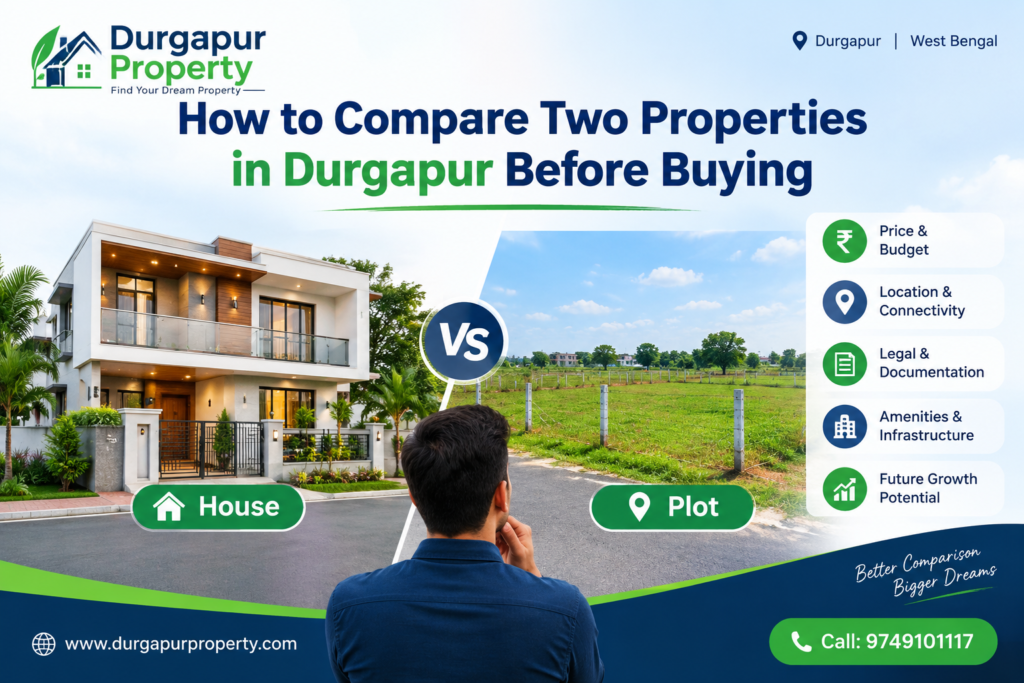
Buying a property is rarely a simple choice between two price tags. Two flats, houses, plots, land parcels or commercial properties can look similar in an online listing and still be very different when you inspect location, documents, access, condition and total cost. If you want to compare properties in Durgapur, the most useful method is to compare both properties against the same checklist instead of making a decision from one attractive feature.
This guide is designed for buyers who are shortlisting property in Durgapur for personal use, family living, investment, rental income or business use. It does not tell you which property to buy. Instead, it gives you a structured way to collect information, identify questions and make your own decision after proper verification.
1. Start With Your Actual Requirement
Before comparing Property A and Property B, write down what you actually need. A property may look attractive but still be unsuitable for your purpose. A family looking for a long-term home may care about schools, daily shopping, transport, water, parking and usable rooms. A buyer considering land may care more about road access, plot dimensions, boundaries, drainage, land records and future construction requirements. A business buyer may care about frontage, visibility, parking, loading access and surrounding commercial activity.
Write a requirement sheet before visiting both properties. Include your maximum budget, preferred locations, property type, minimum usable area, road-access requirements, parking needs, expected possession or availability and intended use. Then apply exactly the same criteria to both properties. This prevents a seller’s sales pitch or a particularly attractive photograph from changing the comparison.
2. Compare the Actual Location, Not Only the Locality Name
Two properties can use the same locality name while having very different practical locations. One may sit close to a main road with easy vehicle access, while another may be inside a narrow internal lane. One may be close to shops and daily services, while the other may require longer travel for routine needs.
When you compare properties in Durgapur, check the exact approach road, distance from the main road, transport options, nearby markets and facilities relevant to your routine. Visit at different times if possible. Morning traffic, evening parking, noise and road activity can be very different.
For land and plots, never depend only on a map pin. Physically inspect the approach road and confirm whether the access shown in the listing actually reaches the property. For important access or boundary questions, verify the relevant records with an appropriate professional.
3. Compare Total Acquisition Cost
The quoted price is only one part of the financial picture. A lower asking price can become more expensive if the property needs major repairs, filling, fencing, renovation, electrical work, parking work or other immediate expenditure.
For a flat, your comparison may include the quoted price, registration-related expenses, applicable statutory charges, parking charges, maintenance deposits, interior work and repairs. For a house, include renovation and structural maintenance where required. For land, consider fencing, boundary work, site preparation, access improvements and professional verification costs. For commercial property, include fit-out, electrical upgrades, signage, storage, parking or business-use requirements where applicable.
Create a two-column sheet: Property A quoted price plus expected additional costs, and Property B quoted price plus expected additional costs. Keep estimates clearly marked as estimates and confirm applicable charges before proceeding.
4. Compare Usable Area and Layout
Area figures can be misleading if different measurement terms are being compared. For flats, understand what the listing means by carpet area, built-up area and other stated measurements. A larger headline number does not necessarily mean more usable living space.
Compare room dimensions, passage space, storage, balcony usability, kitchen arrangement, natural light and ventilation. For houses, separate plot area from built-up area and consider whether the site allows your future plans. For plots, compare frontage and depth as well as total area. Two plots with similar area can have very different shapes and construction possibilities.
The useful question is not simply which property is larger. It is which property provides the usable space required for your purpose without creating unnecessary compromises.
5. Compare Road Access, Frontage and Parking
Road access affects everyday convenience, construction logistics and the practical usefulness of a property. For a home, inspect the approach road, vehicle movement and parking. For a plot, determine the physical road connection, approximate width, turning space and whether the access is usable for construction vehicles when needed.
For commercial property, frontage and visibility can be especially important. A shop that faces an active road may have a different practical use from a similar-sized property hidden behind another building. However, do not assume that a wider road automatically makes a property better for every purpose. Match access to your actual requirement.
Take photographs and notes during the site visit. Record the road condition, parking situation and any access issue that needs document-level verification.
6. Compare Property Condition
For an existing flat or house, inspect walls, ceilings, flooring, doors, windows, plumbing, electrical fittings, dampness, seepage and visible cracks. Look for repeated repairs or signs of moisture. Ask which fixtures are included in the quoted price and which items will be removed before handover.
For land, inspect drainage, slope, vegetation, boundary markers, waterlogging signs and neighbouring construction. A site can look different after rainfall, so ask practical questions about drainage rather than assuming that a dry-day visit tells the whole story.
For a new property, clarify possession status, included fittings, parking, common facilities, maintenance arrangements and any work still pending. Compare both properties using the same inspection list.
7. Compare Documents and Ownership Information
Documentation should be a separate comparison category. Ask for the documents relevant to the property and transaction. Depending on the property, this may include ownership records, previous deeds, mutation or revenue-related records, tax receipts, approved plans, permissions, possession documents and other applicable papers.
Do not treat a photocopy shown by a seller as proof that every legal issue is resolved. Important title, ownership, boundary, land-use and transaction questions should be checked by a qualified property lawyer or other appropriate professional.
When comparing two properties, record which documents have been provided, which items still need verification and whether the names and property descriptions appear consistent. If a cheaper property has an unresolved legal or ownership question, do not treat it as equivalent to a property whose documentation has been independently verified.
8. Compare Water, Electricity, Drainage and Other Utilities
Basic services have a major effect on day-to-day use. Ask about water supply, electricity connection, drainage, waste disposal, internet availability and other utilities important to your household or business.
For flats, ask whether water is individually metered or managed through a common arrangement, how maintenance is collected and whether backup facilities are available. For houses, inspect plumbing and electrical condition. For plots, determine what infrastructure is actually available near the property and what would be required later.
Do not assume that a utility visible somewhere on the main road automatically means a connection is already available at the property. Mark every item as confirmed, needs verification or unavailable.
9. Compare Neighbourhood Practicality
A property is part of its surrounding environment. During the site visit, observe neighbouring buildings, road activity, noise, parking, drainage, shops, access and general movement. Think about your normal routine rather than only the property itself.
If you are buying a family home, consider how the location fits commuting, school travel, shopping and everyday services. If you are considering investment, collect evidence about current connectivity, surrounding development and existing property supply instead of relying on unsupported predictions about future prices.
If a seller mentions an upcoming road, project or facility, verify the claim through an appropriate official source before treating it as a decision factor.
10. Compare Floor, Light and Ventilation for Flats
When comparing two flats, note the floor, orientation, window positions, natural light and ventilation. A flat that looks spacious in photographs can feel different when furniture, wardrobes and appliances are installed.
Visit the rooms rather than judging from the living room alone. Check bedrooms, kitchen, bathrooms and balconies. Notice whether windows face another building at very close distance, whether common areas are noisy and whether the layout supports your daily routine.
Also compare lift access, staircase condition, power backup, water arrangements, parking and common-area maintenance. These factors can affect practical convenience even when the apartment’s advertised area is similar.
11. Compare New and Resale Properties Carefully
A new property and a resale property should not be compared only by price per square foot. A new property may have newer fittings and lower immediate repair needs, while a resale property allows you to inspect the actual condition of the building and surrounding environment.
For a resale property, inspect maintenance history and visible defects. For a new property, verify what is included, the possession status and the applicable documents and approvals. In both cases, compare total cost and suitability for your own requirement.
12. Compare Plot Shape, Frontage and Boundaries
For land buyers, plot shape is an important practical factor. A rectangular plot with useful frontage can be easier to plan than an irregular plot of similar area, but the right choice depends on the intended construction and site conditions.
Measure or independently verify important dimensions. Inspect boundary markers and compare the physical site with the description in relevant documents. Check whether any neighbouring structure appears to cross or affect the stated boundary. Do not make a purchase decision from a hand-drawn sketch alone.
13. Compare Commercial Property for Business Use
Commercial buyers should compare customer access, road visibility, frontage, parking, loading, surrounding activity, floor layout and suitability for the intended business. A larger property is not necessarily more useful if customers cannot easily reach it.
Ask whether the proposed business use is permitted and verify applicable requirements with the relevant authorities or professionals. Compare recurring costs and any work required before opening the premises.
14. Use a Weighted Comparison Sheet
A weighted comparison sheet can make your priorities visible without pretending that a mathematical score can replace professional verification. You can assign weights according to your own needs.
- Location and connectivity — 20%
- Total cost — 20%
- Documents and ownership verification — 20%
- Usable space and layout — 10%
- Road access and parking — 10%
- Condition — 10%
- Utilities and neighbourhood — 10%
These are only example weights. Change them for your situation. A commercial buyer may give more attention to frontage and access. A land buyer may give greater importance to documents, boundaries and road access. If information is missing, mark the category as “needs verification” instead of assuming the answer is favourable.
15. Ask Both Sellers the Same Questions
Consistency is essential. Ask both sellers substantially the same questions: Who owns the property? What documents are available? What is the exact area? What is included in the price? What is the road access? What utilities are available? What repairs are needed? What are the recurring charges? When can possession happen? Are there restrictions on the intended use?
Also ask why the property is being sold or rented, but treat the answer as information rather than proof of anything. If a seller makes a material claim, verify it independently where appropriate.
16. Keep a Site Visit Record
Take a checklist with you and record the exact location, visit date, road condition, property dimensions, parking, light, ventilation, water, electricity, drainage, visible defects, neighbourhood conditions, documents shown and questions requiring follow-up.
Take photographs where permitted and label them clearly. When several properties are visited in a short period, photographs and notes can prevent details from being mixed up. Try to visit both properties within a similar time window so that traffic and neighbourhood conditions are easier to compare.
17. Watch for Information That Needs Extra Verification
Some situations deserve additional verification: pressure to transfer money immediately, inconsistent area measurements, unclear ownership, missing documents, unexplained differences between the advertisement and the physical property, access that appears different from the listing, unusual payment instructions or claims that cannot be independently confirmed.
A warning sign does not automatically prove that a property is unsuitable. It means you should investigate before proceeding. Never allow urgency to replace document and property verification.
18. Use Online Listings for Shortlisting, Not Final Verification
Online property portals can save time because they allow buyers to collect information before arranging site visits. Durgapur Property focuses on property discovery in Durgapur and can help buyers review available listings for homes, flats, plots, land and other categories.
Use online information as a shortlist. Confirm the actual location, condition, area, price and availability with the listing source, then visit the property. Important legal and financial questions should be verified before making a binding commitment.
For buyers who need related technology or security services after moving, Mithu Tech Group provides technology, website and CCTV-related services. For household and local doorstep service requirements, GitaKart Seva lists multiple service categories. These are separate service providers; confirm service scope and pricing directly before ordering.
19. Questions to Ask Yourself Before Choosing
After collecting the evidence, ask yourself which property better matches your actual requirement, which one fits the total budget more comfortably, which one has fewer unresolved questions, which one offers the usable space you need, and which one can work for your likely routine.
Do not force a decision when important information is missing. Sometimes the right next step is another site visit, another document check or professional advice. A comparison is useful precisely because it shows what you know and what you still need to verify.
20. Final Side-by-Side Checklist
Create a final comparison sheet before making a decision:
- Exact location and approach road
- Property type and intended use
- Total area and usable area
- Frontage and dimensions where applicable
- Parking and vehicle access
- Water and electricity
- Drainage and surrounding conditions
- Property condition and repair requirements
- Documents available
- Ownership information
- Quoted price
- Estimated additional cost
- Recurring maintenance or operating cost
- Questions still pending
- Professional verification required
Once the sheet is complete, you will have a much clearer picture of the two properties. The purpose is not to produce a universal “winner.” The purpose is to make your own decision using comparable, verified information.
Conclusion
To compare properties in Durgapur properly, look beyond the asking price. Compare location, access, total cost, usable area, condition, utilities, documents, neighbourhood and your intended use. Ask both sellers the same questions, keep site-visit records and verify important claims independently.
Whether you are considering a flat, house, plot, agricultural land or commercial property, a structured comparison can reduce avoidable surprises. Online listings are useful for shortlisting, but physical inspection and appropriate legal or professional verification remain important before a binding transaction.
Frequently Asked Questions
What is the first thing to compare between two properties in Durgapur?
Start with your actual requirement and then compare location, total cost, usable space, access and documentation using the same checklist.
Should I choose the cheaper property?
Not automatically. Compare the total expected cost, condition, documentation, access and suitability rather than only the asking price.
How should I compare two plots?
Check location, road access, frontage, dimensions, boundaries, relevant documents, drainage, intended use and surrounding conditions.
How should I compare two flats?
Compare usable area, layout, floor, light and ventilation, parking, lift, power backup, water, maintenance, building condition and documentation.
Should I verify documents before paying a token?
Important ownership and transaction information should be checked before making a financial commitment. A qualified property lawyer or appropriate professional can assist with legal verification.
Can online listings replace a site visit?
No. Online listings are useful for shortlisting, but a physical visit helps you check actual access, condition, surroundings and practical details.
[…] How to Compare Two Properties in Durgapur Before Buying […]
[…] more buyer guidance, see Durgapur Property for First-Time Buyers, How to Compare Two Properties in Durgapur, and the Durgapur Property […]
[…] more buyer guidance, see Durgapur Property for First-Time Buyers, How to Compare Two Properties in Durgapur, and the Durgapur Property […]
[…] more buyer guidance, see Durgapur Property for First-Time Buyers, How to Compare Two Properties in Durgapur, and the Durgapur Property […]
[…] more buyer guidance, see Durgapur Property for First-Time Buyers, How to Compare Two Properties in Durgapur, and the Durgapur Property […]