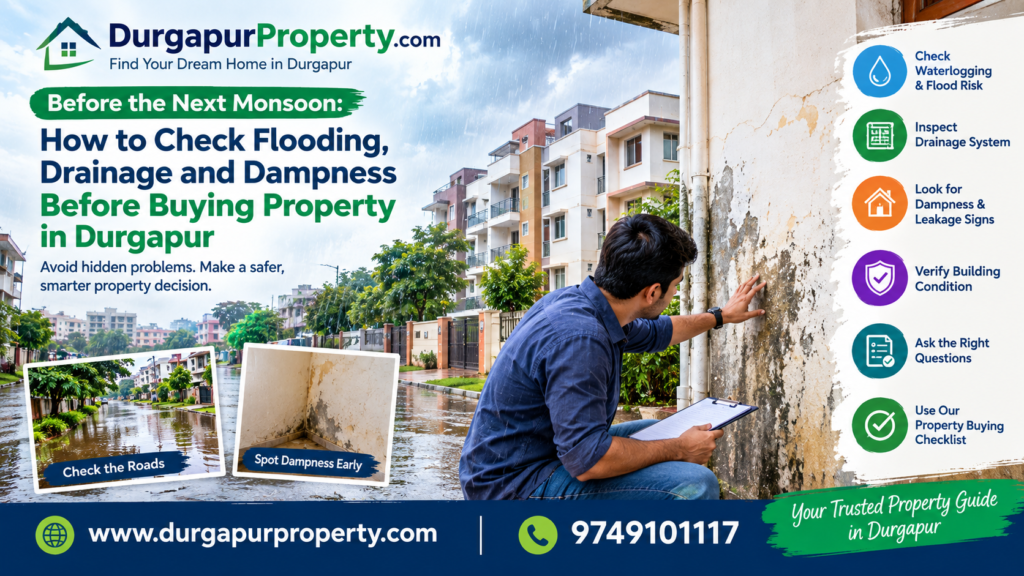
Before the Next Monsoon: How to Check Flooding, Drainage and Dampness Before Buying Property in Durgapur
· Durgapur Property
By the DurgapurProperty.com Editorial Team
Buying a house is exciting. You imagine arranging the furniture, setting up your kitchen, choosing your bedroom, and finally having a place that feels like your own. When a property looks beautiful during a sunny afternoon visit, it is easy to imagine moving in without a second thought.
But there is one question every serious homebuyer in Durgapur should ask before committing a large amount of money: What happens to this property when heavy rain arrives?
A residential property may look perfectly fine in dry weather and reveal a different set of problems during the monsoon. Rainwater may collect on the approach road, drains may struggle to carry runoff, exterior walls may allow moisture to enter, and poorly maintained terraces may develop leaks. Ground-floor rooms, parking areas and low-lying plots can also require additional investigation.
These problems are not limited to one type of home. They can affect independent houses, apartments, older buildings, newly completed projects and residential plots. The actual risk depends on the property’s position, construction quality, drainage arrangements, maintenance and surrounding land.
For anyone searching for property in Durgapur, understanding these issues before purchasing can help prevent unexpected repair expenses and daily inconvenience.
This guide explains how to inspect a house or flat for flooding, waterlogging, drainage problems and dampness before buying. It also includes questions to ask the seller, warning signs to photograph, a practical inspection checklist and steps to take before paying a booking amount or signing a sale agreement.
If you are planning to buy a home in Durgapur in 2026, use this guide alongside a physical site visit and appropriate professional advice.
Quick Answer: How Can You Check a Property for Monsoon Problems?
Before buying a property in Durgapur, inspect both the building and the surrounding neighbourhood. Do not limit your inspection to the rooms, flooring and decorative finishes.
Start with these essential checks:
- Visit the property after rainfall if practical.
- Inspect the approach road, nearby drains and low-lying areas.
- Look for damp patches, peeling paint, mould-like staining and damaged plaster.
- Check the ceiling, terrace, balconies, windows and bathroom walls for signs of leakage.
- Ask residents whether water collects near the building during heavy rain.
- Check whether water enters parking areas, basements or ground-floor rooms.
- Ask how roof drains, rainwater pipes and common drainage systems are maintained.
- Request details of previous repairs and recurring water-related problems.
- Obtain a qualified inspection if there are significant cracks, persistent dampness or suspected structural defects.
- Include unresolved issues in your purchase decision before making a substantial payment.
A single visit cannot establish that a property is free from water-related problems. The purpose of an inspection is to identify warning signs, ask the right questions and determine what needs further verification.
1. Why Monsoon Inspection Matters When Buying Property in Durgapur
Durgapur experiences seasonal rainfall, and the condition of an individual property during wet weather can be different from what a buyer observes during a dry-season visit.
Rainwater needs somewhere to go. Roads, rooftops, paved courtyards and neighbouring plots all influence how water moves through an area. If a drain is blocked, the ground slopes towards a building or the surrounding drainage system is inadequate, water may collect where it creates problems.
A building can also have internal moisture issues that are not immediately obvious. Damaged waterproofing, defective plumbing, leaking rainwater pipes and poorly sealed windows can allow water into walls and ceilings.
For homebuyers, these conditions matter for several reasons.
First, water-related damage can create repair expenses after possession. Depending on the severity, repairs may involve repainting, plaster replacement, roof waterproofing, drainage improvements or plumbing work.
Second, persistent moisture can damage finishes and belongings. It can also contribute to indoor mould growth where moisture remains and ventilation is inadequate.
Third, external waterlogging may affect daily access. A house can be difficult to reach during heavy rain even if the interior remains dry.
Finally, repeated water problems can affect how comfortable a property is to live in and may complicate future maintenance or resale.
This does not mean that every property in Durgapur has a drainage problem. It means that buyers should verify the actual conditions of the street, building and plot rather than assuming that a good-looking property will perform well in every season.
2. Start With the Location, Not the Living Room
When visiting a property, buyers often walk directly through the entrance and begin examining the interiors. That is understandable, but the inspection should begin outside.
The surroundings help you understand where rainwater might travel and whether the building is exposed to obvious drainage concerns.
Inspect the approach road
Look at the road connecting the main route to the property entrance.
Check whether the road surface is noticeably lower than adjoining plots, whether there are depressions where water could collect, and whether the entrance is difficult to access without crossing an open drain or uneven surface.
Look for water marks, deposited mud, damaged road edges and other signs that may justify further investigation. These clues do not prove that flooding occurs, but they can help you identify questions for residents.
Also consider whether the road remains accessible to pedestrians, two-wheelers and emergency vehicles during poor weather.
A property may be located in a popular residential locality yet have an inconvenient approach road. The exact street matters.
Look at the level of the property
Observe how the building entrance relates to the road, pavement and surrounding land.
A floor that sits lower than the adjacent road may need additional attention, especially where water can flow towards the entrance. A raised entrance can help in some situations, but it does not guarantee protection against waterlogging.
For a plot, look at the general ground level and whether neighbouring land appears higher or lower. Do not rely on visual estimation alone if the land level will affect construction or drainage design.
A qualified surveyor or relevant technical professional can help assess significant level differences and drainage questions.
Examine nearby drains
Check whether drains are present along the road and whether they appear maintained.
Look for visible blockages, accumulated waste, damaged covers, stagnant water and points where the drainage path seems interrupted. Observe whether the drain has a clear outlet where that can be safely and lawfully assessed.
Do not enter a drain or attempt to remove blockages yourself.
Remember that an apparently clean drain during dry weather does not prove that it can handle heavy rainfall. Ask residents about actual performance during the monsoon and seek local information where available.
Check neighbouring properties
Observe whether nearby homes have raised entrances, water barriers, pumps or visible signs of repeated repairs.
These features are not proof of flooding. They may exist for other reasons. However, they can be useful prompts for further questions.
Speak politely with residents if they are willing to share their experiences. Ask specific questions rather than asking whether the whole locality is good or bad.
For example, ask whether water ever enters the lane, how long standing water remains after heavy rain and whether vehicles can reach the building during difficult weather.
3. How to Identify Waterlogging Risk Before Buying a House
Waterlogging refers to water collecting in an area where it interferes with normal use or drainage. The severity can range from temporary puddles to persistent standing water that affects access or buildings.
A buyer should distinguish between a small amount of temporary surface water and a recurring problem that affects the property.
Look for physical clues
During a site visit, examine:
- Mud or debris deposited near entrances.
- Water marks on boundary walls.
- Damaged plaster close to ground level.
- Repeated patches of recently repaired exterior paint.
- Soil erosion around the building.
- Low points in the road or courtyard.
- Areas where water appears unable to drain away.
- Evidence of repairs to entrances or parking areas.
These clues should be interpreted carefully. A mark on a wall may have another cause, and fresh paint is not evidence of concealment by itself.
The correct approach is to note the observation, ask for an explanation and investigate further when the issue could materially affect your purchase.
Ask about previous rainfall
Ask the seller and nearby residents what happened during recent periods of heavy rain.
Useful questions include:
- Has water entered the building or plot?
- Has the approach road become difficult to use?
- Does water remain outside the property after the rain stops?
- Has a pump been needed to remove water?
- Have any drainage repairs been carried out?
- Does the problem happen every year or only under particular conditions?
Ask when the incident occurred and which part of the property was affected.
If answers differ, do not immediately assume that one person is being dishonest. Conditions may vary between neighbouring buildings or different rainfall events. Record the differences and seek more information.
Check access at different times
A property can be easy to reach during the day but inconvenient during evening traffic or heavy rain.
If possible, visit at different times and observe the surrounding road, parking conditions and pedestrian access.
For a household with children, older family members or someone with mobility requirements, reliable access can be especially important.
Do not depend only on online maps
Maps can help you understand the area’s layout, roads and surrounding features, but they do not establish the property’s drainage performance.
Use maps as a starting point. Confirm conditions through observation, local information and appropriate professional assessment.
4. Damp Walls: Warning Signs Buyers Should Never Ignore
Dampness is one of the most common issues buyers should investigate when inspecting a house or apartment.
Moisture can enter a building through a leaking roof, damaged external walls, defective plumbing, poorly sealed windows or inadequate protection against ground moisture. Condensation may also create moisture on cool surfaces where ventilation is insufficient.
The visible signs may look similar even when the underlying causes are different.
That is why it is important not to assume that every damp patch can be solved simply by repainting the wall.
Look for peeling or bubbling paint
Paint that peels, bubbles or separates from the wall may indicate moisture, poor surface preparation or another maintenance issue.
Inspect the affected area closely. Check whether the damage is concentrated near the floor, around a window, beneath a ceiling or beside a bathroom.
Ask whether the area has been repaired before and whether the problem returned.
A fresh coat of paint does not establish that the underlying cause has been corrected.
Check for discoloured patches
Yellow, brown or irregular marks may appear where water has entered a wall or ceiling.
Photograph any significant patch and ask the seller about its history.
If the mark is on a ceiling, investigate the roof, terrace, bathroom or plumbing located above it. If it appears on an external wall, inspect the exterior finish and nearby rainwater arrangements.
The visible location is a clue, not a final diagnosis.
Notice musty smells
A persistent musty smell may indicate moisture or inadequate ventilation.
Check enclosed rooms, cupboards, corners, bathrooms and areas behind furniture where air circulation may be limited.
Ask whether the room has been kept closed for a long period or whether there has been a previous leakage problem.
If there is visible mould or a strong persistent odour, consider a professional assessment before purchasing.
Look behind movable furniture where permitted
Furniture can conceal stains, peeling paint and other signs of moisture.
With the owner’s permission, inspect accessible areas behind wardrobes, beds and cupboards. Do not move heavy furniture or disturb the property without permission.
Pay attention to external corners, lower wall sections and places where plumbing runs through the building.
Why dampness needs a proper diagnosis
Different moisture problems require different solutions.
A plumbing leak may need pipe repair. A terrace leak may require waterproofing work. Poor ventilation may need a different remedy. Water entering from the ground or surrounding land can require specialist investigation.
Before agreeing to a purchase, establish the likely cause, the scope of the repair and who will be responsible for completing it.
Where the cause is uncertain, obtain a qualified inspection rather than accepting a verbal assurance that the issue is minor.
5. How to Inspect the Roof, Terrace and Ceiling
Water entering from above can damage paint, plaster, electrical fittings and other interior components.
Roof and terrace inspections are particularly important for top-floor flats, independent houses and properties with accessible terraces.
Inspect the ceiling inside the property
Look for irregular stains, peeling paint, damaged plaster, bubbling surfaces and visible cracks.
Pay particular attention to ceiling areas beneath a terrace, bathroom or plumbing installation.
If the ceiling has been recently painted, ask whether there was a previous leak and whether the underlying repair was completed.
Do not assume that every crack is a structural defect. However, significant, widening or recurring cracks should be assessed by a qualified professional.
Check the terrace where access is permitted
Observe the visible condition of the waterproofing surface, joints, parapet walls and rainwater outlets.
Look for standing water, damaged finishes, loose material and outlets that appear obstructed.
A terrace should allow rainwater to drain appropriately. Persistent ponding may indicate a maintenance or design issue that deserves investigation.
Do not climb onto unsafe roofs or access restricted areas without permission and suitable precautions.
Inspect rainwater pipes
Rainwater pipes carry water away from roofs and terraces. Damaged joints, disconnected sections or visible leaks can direct water towards walls and foundations.
Look for broken brackets, detached pipe sections, visible staining and water discharge near entrances.
Ask who maintains the rainwater system and whether recurring problems have been reported.
Ask about repair records
If the seller reports that a roof leak has been repaired, ask what work was done and when.
Receipts, maintenance records, contractor details or other available documentation can help clarify the history. Their existence does not guarantee that the repair was successful, so inspect the affected area as well.
For an apartment, ask the building management who is responsible for shared terraces, roof waterproofing and common rainwater pipes.
6. Bathrooms, Kitchens and Hidden Plumbing Leaks
Water problems do not always come from rain.
Bathrooms, kitchens, utility areas and concealed pipes can develop leaks that damage walls, ceilings and floors.
These issues can be difficult to identify from photographs or a quick viewing.
Inspect bathroom walls and floors
Look around shower areas, taps, basins, toilets, floor drains and pipe connections.
Check for damaged grout, loose tiles, recurring dampness, peeling paint in adjoining rooms and unusual odours.
Ask whether water has leaked into the flat below or neighbouring rooms.
In an apartment, recurring bathroom leakage can become a dispute between residents if the source and responsibility are unclear. Establish the likely cause before committing to a repair arrangement.
Check kitchen plumbing
Inspect the visible connections beneath the sink and around the water supply.
Look for corrosion, damp cabinets, swollen wooden panels, staining and water marks.
If the property is occupied, request permission to operate taps and observe whether visible connections remain dry during normal use.
Do not dismantle fittings or plumbing without permission.
Examine ceilings below bathrooms
If the property is on a lower floor, check ceilings directly beneath bathrooms or kitchens where accessible.
Staining, damaged paint or plaster may justify further investigation into plumbing above.
Ask the seller or building management whether previous leaks have been reported and what repairs were completed.
Confirm who is responsible
In apartment buildings, the responsibility for pipes and drainage can depend on whether the affected component serves one unit or is part of a shared system, as well as the applicable agreements and rules.
Ask the association or management to explain the arrangement. Do not assume that every repair will automatically be paid for by the building or by an individual owner.
7. Ground-Floor Flats, Basements and Parking Areas
Properties at or below surrounding ground level deserve particular attention when investigating water entry.
This does not mean that every ground-floor home or basement is unsuitable. It means that the buyer should understand the actual design, drainage and protection arrangements.
Ground-floor flats
Check the entrance level, surrounding paving, exterior wall condition and visible dampness.
Ask residents whether rainwater has entered the flat or common corridors. Look for recurring water marks around doors and the lower sections of walls.
Consider how easily rainwater could flow from the road or courtyard towards the entrance.
Basement parking
If the building has basement parking, inspect the visible floor, walls, ramps and drainage arrangements.
Ask whether water has collected in the basement during heavy rain, whether pumps are installed and who maintains them.
A pump is a piece of equipment, not proof that the building is protected against every possible event. Ask about maintenance and previous incidents.
Independent houses with low entrances
Inspect the relationship between the gate, courtyard and house entrance.
If the courtyard slopes towards the building, ask how runoff is managed. Check the visible drainage channels and whether the entrance has been altered to address previous problems.
Where water could affect the building, seek a technical assessment of the proposed solution.
Residential plots
For a vacant plot, look at the ground level, surrounding land, road connection and visible drainage route.
Ask about any history of standing water, soil movement or filling work. Verify the plot boundaries and relevant records separately.
Before planning construction, consult qualified professionals about site levels, drainage and the suitability of the proposed design.
8. What Should You Ask Neighbours Before Buying?
Neighbours can provide useful information about how a location performs in everyday conditions.
They may know whether water regularly collects on the road, whether a building has recurring leakage problems or whether access becomes difficult during heavy rain.
However, their observations should be treated as one source of information rather than definitive proof.
Ask specific, neutral questions
Instead of asking, “Is this area good?”, try questions such as:
- Does water collect on this road during heavy rainfall?
- How long does it usually take for the water to drain?
- Has water entered the building or parking area?
- Are there recurring roof or wall leakage issues?
- Has the drainage system been repaired recently?
- Does access become difficult during the monsoon?
- Are there maintenance issues residents are currently addressing?
Specific questions often produce more useful answers than broad opinions.
Speak with more than one person
Conditions may differ between buildings, streets and plots.
Where possible, compare observations from more than one resident and ask whether the information refers to the exact property you are considering.
A problem reported in a neighbouring street may not affect your property. Conversely, a seller may not know about a recurring issue that appears only during particularly heavy rainfall.
Respect privacy and safety
Do not enter neighbouring properties or restricted areas without permission. Avoid asking residents to disclose private information about other owners.
The purpose is to understand local conditions, not to investigate personal matters.
9. What If You Cannot Visit During the Monsoon?
Many buyers have to make their initial shortlist during dry weather. You may also be relocating from another city and unable to schedule repeated visits.
In that situation, use additional checks to reduce uncertainty.
First, ask the seller for information about previous water-related incidents and repairs. Request photographs, invoices or maintenance records where available.
Second, ask nearby residents or the building association about the road and building’s history during heavy rain.
Third, inspect the property carefully for visible signs of moisture, repairs, drainage defects and water marks.
Fourth, arrange a second visit if the property remains a serious candidate. A trusted representative or qualified inspector may be able to help with observations if you cannot attend personally.
Fifth, consider a professional building inspection where the potential cost of hidden defects is significant.
No single substitute fully reproduces a visit during heavy rain. A dry-weather inspection should therefore be recorded as a limitation rather than treated as proof that the property has no monsoon-related risks.
10. How to Estimate the Cost of Water-Related Repairs
A property with visible dampness or drainage issues is not automatically a bad purchase. The important questions are what caused the problem, how serious it is, what it will cost to correct and whether the solution is practical.
Separate cosmetic repairs from underlying problems
Repainting a wall may be relatively straightforward, but it does not solve a continuing leak.
Similarly, replacing damaged plaster will not correct a blocked drain or a defective pipe.
Before estimating costs, identify the likely source and obtain a suitable repair recommendation.
Obtain written estimates
If repairs are required, ask an appropriately qualified contractor or specialist to inspect the problem and provide an itemised estimate.
The estimate should distinguish between the work needed to address the cause and the work needed to restore damaged finishes.
Where multiple solutions are proposed, understand their limitations and expected maintenance requirements.
Calculate the complete cost
Use this simple framework:
Estimated property cost after repairs = Purchase price + applicable transaction costs + inspection or professional fees + immediate repair expenses.
Add an appropriate contingency based on the condition of the property and the advice you receive.
Do not use an arbitrary repair allowance as a substitute for investigating a significant defect.
Decide whether to negotiate or walk away
If the problem is manageable and the repair scope is clear, you may be able to discuss the price or written repair arrangements with the seller.
If the cause is unknown, the likely expense is substantial or the necessary work cannot be completed safely, it may be better to delay the transaction or consider another property.
Do not make a decision based only on the seller’s estimate of repair costs.
11. Should You Buy a New Property to Avoid Monsoon Problems?
New construction can offer modern layouts and recently installed building systems, but it is not automatically free from leakage or drainage problems.
Construction quality, waterproofing details, roof drainage, site levels, workmanship and ongoing maintenance all influence performance.
A recently completed building may also have had limited exposure to several monsoon seasons. This means there may be less evidence about how it performs under prolonged rainfall.
Inspect the actual building
Where possible, visit the actual unit rather than relying only on a model flat or promotional images.
Inspect windows, balconies, bathrooms, external walls and common areas.
Ask about terrace waterproofing, rainwater pipes and the maintenance arrangements for shared facilities.
Check the surrounding site
Observe whether the surrounding roads and access routes are complete and whether drainage work is visible.
For an under-construction project, ask which parts are completed and which facilities are still planned.
Do not assume that future infrastructure will be completed on a particular date unless the relevant information and contractual commitments support that expectation.
Verify project documentation
Where applicable, review project registration and disclosures through the official West Bengal Real Estate Regulatory Authority portal:
The portal is a starting point for regulatory verification. It does not replace legal advice or inspection of the specific unit.
12. Legal and Documentation Checks Before Paying a Token
A property can have physical maintenance issues and separate legal issues. Both need attention before a purchase.
The precise documents depend on whether you are buying a flat, independent house, plot or under-construction unit.
Ask an independent property lawyer to identify the documents and checks relevant to your transaction.
Verify ownership and title
Confirm that the seller has the legal right to sell the property and review the relevant ownership records.
Do not assume that a property is legally clear simply because the seller possesses keys or has occupied it for several years.
Review approvals and permitted use
For land and buildings, verify applicable land-use requirements, permissions and building records.
If you intend to construct, extend or substantially alter a property, establish whether the proposed work is permitted.
Review the written agreement
Check the agreed price, payment schedule, possession terms, repair responsibilities and the consequences of non-compliance.
If the seller agrees to complete a drainage or waterproofing repair before possession, obtain clear written terms describing the work, timeline and responsibility.
Do not rush payments
Before paying a substantial or non-refundable amount, ensure that the relevant checks have been completed and that you understand the contractual implications.
If a material question remains unresolved, seek professional advice before proceeding.
13. A Property Inspection Checklist You Can Save
Use the following checklist during site visits in Durgapur.
Outside the property
- Inspect the approach road and entrance level.
- Observe nearby drains and visible blockages.
- Look for water marks, mud deposits and damaged exterior surfaces.
- Check whether the surrounding land slopes towards the property.
- Ask residents about waterlogging during heavy rain.
- Inspect access to parking and common entrances.
Inside the property
- Look for damp patches and peeling paint.
- Inspect ceilings and walls for water stains.
- Check bathrooms and kitchens for visible leaks.
- Inspect accessible areas behind furniture with permission.
- Look for damaged plaster, unusual smells and signs of moisture.
- Ask about previous repairs and recurring problems.
Roof and common areas
- Inspect the terrace if access is permitted.
- Check visible rainwater pipes and outlets.
- Ask who maintains shared drainage systems.
- Inspect the parking area and basement, where applicable.
- Ask about previous water-entry incidents.
Before making a decision
- Obtain repair estimates for significant defects.
- Compare the full purchase cost, including repairs.
- Verify relevant legal documents independently.
- Record unresolved questions in writing.
- Seek professional advice where necessary.
- Avoid relying solely on photographs or verbal promises.
Keep photographs and notes together for each property. A consistent checklist makes it easier to compare several homes without forgetting important details.
14. How to Compare Two Properties With Different Monsoon Risks
Imagine you are considering two homes in Durgapur.
Property A is less expensive but has visible dampness near a bedroom window and an approach road where water appears to collect. The seller says the problem is minor, but there are no repair records.
Property B costs more, but the walls appear dry, the access road is better maintained and the seller can provide details of recent maintenance. You still need to verify the information, but fewer questions remain unresolved.
Which property is better?
There is no automatic answer. Property A might still be suitable if the cause of the dampness is identified and the repair is manageable. Property B may also have hidden issues that require investigation.
Use the following comparison:
| Inspection factor | Property A | Property B |
|---|---|---|
| Purchase price | Record actual quote | Record actual quote |
| Visible dampness | Record findings | Record findings |
| Drainage and access | Record observations | Record observations |
| Repair history | Request evidence | Request evidence |
| Estimated repair cost | Obtain estimate | Obtain estimate if needed |
| Legal verification | Confirm separately | Confirm separately |
| Remaining uncertainty | List open questions | List open questions |
The aim is not to choose the property with the best appearance. It is to choose the property that best fits your budget and requirements after the important facts have been checked.
15. Where to Start Your Property Search in Durgapur
Finding the right home begins with a shortlist that reflects your actual needs.
Before contacting sellers, establish your budget, preferred property type, required space, commuting needs and essential services.
Then compare available properties using consistent criteria. A listing should help you decide which homes are worth investigating, not replace inspection or verification.
You can begin exploring options on DurgapurProperty.com, where you can research property information and continue your search.
For additional guidance, read our related article, How to Inspect Water Supply Before Buying Property in Durgapur. Water supply, storage, drainage and maintenance are all relevant to understanding whether a property will work well for everyday living.
You can also follow our step-by-step guide to buying property in Durgapur to organise your search, inspection and verification process.
These resources should be used together: the water-supply guide focuses on everyday water arrangements, while this article concentrates on rainfall, drainage and moisture-related warning signs.
What to include in your first enquiry
When contacting a seller or property representative, explain what type of property you want, your approximate budget and your preferred location.
Ask whether the property can be inspected in person and whether relevant details and documents are available.
If you have a particular concern about dampness or drainage, mention it before the visit so that you can ask focused questions.
Avoid sending money merely to secure a viewing or because an online listing claims that an opportunity is about to disappear.
16. Related Property and Technology Resources
Property buyers sometimes need assistance with several aspects of a move, from finding a suitable home to understanding the services available for their property-related needs.
For general information about technology and business services, you can also visit MithuTech.com. Explore the provider’s website to determine whether any of its listed services match your specific requirements.
Keep your property decision separate from unrelated service purchases. The priority when buying a home should remain the suitability of the property, the total cost, the physical inspection and the legal verification.
Frequently Asked Questions
1. How do I check for waterlogging before buying a house in Durgapur?
Inspect the approach road, nearby drains, entrance level and surrounding land. Ask residents about recent heavy rainfall and visit after rain if possible. Look for physical evidence, but do not treat any single sign as conclusive proof.
2. What are the signs of dampness in a house?
Possible warning signs include peeling paint, discoloured patches, damaged plaster, musty smells, visible mould and recurring moisture near windows, ceilings or bathrooms. The cause should be investigated before deciding how to repair it.
3. Should I avoid a property with damp walls?
Not necessarily. Some moisture problems can be repaired, while others may indicate more serious or recurring issues. Identify the cause, obtain an appropriate assessment and understand the likely repair cost before making a decision.
4. How can I tell whether a terrace is leaking?
Look for ceiling stains beneath the terrace, damaged waterproofing, visible cracks, defective rainwater outlets and recurring dampness. A qualified professional can help identify the cause where the evidence is unclear.
5. Is a newly constructed flat free from leakage problems?
No. New construction can still have defects in waterproofing, plumbing, windows or drainage. Inspect the actual unit and common areas, ask about maintenance arrangements and review the relevant project documentation.
6. What should I ask neighbours before buying property?
Ask whether the road experiences waterlogging, whether water has entered the building, how long standing water remains and whether roof or drainage repairs recur. Compare information from more than one source where possible.
7. Can I check a property during dry weather?
Yes, but a dry-weather visit cannot establish how the property performs during heavy rainfall. Inspect visible warning signs, review repair history, ask local residents and consider another visit or professional assessment.
8. Who should inspect serious dampness or cracks?
Depending on the problem, you may need a qualified building inspector, structural engineer, waterproofing specialist or plumber. Legal questions should be referred to an independent property lawyer.
9. Should the seller repair drainage problems before the sale?
That depends on the issue and the terms agreed by both parties. If repairs are part of the transaction, document the scope, responsibility and timing in writing and obtain professional advice where appropriate.
10. What is the most important monsoon check before buying a house?
There is no single check that covers every risk. Examine the surrounding drainage and access, inspect the building for moisture, ask about previous incidents and verify the information that matters to your purchase.
Final Verdict: Inspect Before You Invest
A beautiful home can still have practical problems that are difficult to spot during a short visit. When buying property in Durgapur, take the time to inspect the surrounding road, drainage, walls, roof, plumbing and common areas.
Visit at different times when possible. Ask residents specific questions. Request repair records where available. Get professional advice for significant defects and verify the relevant legal documents before making a substantial commitment.
The purpose of a monsoon inspection is not to find a reason to reject every property. It is to understand the risks, estimate the likely costs and make an informed decision.
A well-chosen property should suit your family’s needs throughout the year—not only on the sunny day when you first visited it.
Looking for a home in Durgapur? Start your search on DurgapurProperty.com, shortlist properties that fit your budget and use this inspection guide before committing to a purchase.
Disclaimer: This article is for general educational purposes and does not establish the condition of any particular property or locality. Weather conditions, drainage performance, building defects, legal requirements and repair costs vary. Verify relevant information through site inspections, qualified professionals and appropriate authorities before making a property decision.
Leave a Reply