How to Verify Building Plan Approval Before Buying a Flat in Durgapur
· Durgapur Property
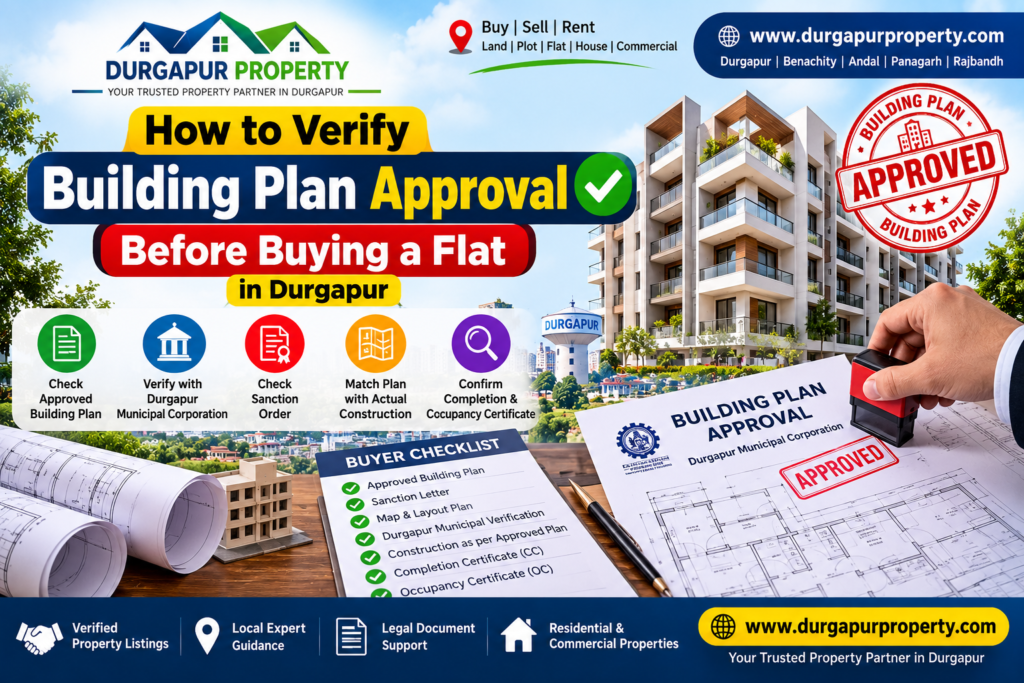
Buying a flat in Durgapur is not only about checking the location, price, carpet area and amenities. A buyer should also understand whether the building has the relevant plan approval and whether the flat being offered is consistent with the sanctioned building plan. Building-plan verification can help identify differences between approved construction and what exists on site before a buyer commits a large amount of money.
Why Building Plan Approval Matters
A sanctioned building plan is the approved construction layout against which important aspects of a project can be compared. Depending on the project and applicable local rules, approvals can relate to the site, building use, floor configuration, setbacks, access, parking, common areas and other construction parameters. Buyers should not assume that a brochure, sales drawing or marketing plan is the same thing as an approved plan.
For a flat buyer, the practical objective is simple: establish what has been approved, what has actually been constructed, and whether the unit being sold fits within the approved documentation. This is particularly important for new projects, extensions, converted structures and properties where the seller has made changes after the original construction.
1. Ask the Seller or Developer for the Approved Plan
Start by asking for a copy of the sanctioned or approved building plan applicable to the property. Ask for the approval reference, issuing authority and relevant date. Keep the document in your own due-diligence folder instead of relying only on a salesperson’s verbal explanation.
Check whether the document clearly relates to the same plot, project and building that you are considering. If the project has multiple blocks or phases, identify the block and phase specifically. A plan for one building should not automatically be treated as approval for another building.
2. Compare the Project Address and Plot Details
Property documents can contain different descriptions for the same site. Compare the project address, plot or premises information, land description and seller/developer details across the building plan, title documents, agreement and registration papers.
If the documents use different plot descriptions, do not ignore the difference. Ask for a written explanation and supporting documents. A buyer should be able to trace the approved building back to the land on which it stands.
3. Check the Number of Floors
One of the easiest practical checks is the number of floors. Compare the approved floor configuration with the building visible on site. If the approval shows a different number of floors or a different building configuration, ask why.
Do not assume that a later approval exists simply because a salesperson says that the extra construction was regularised. Ask to see the relevant approval or revised plan. The date and scope of any revised approval should be understood before relying on it.
4. Verify the Flat Location and Unit Number
Match the flat number, floor, block and approximate position of your unit with the relevant plan. For larger projects, also identify the tower or wing. This helps prevent confusion between marketing plans and approved layouts.
Keep copies of the floor plan, unit schedule and agreement. If the agreement describes a unit differently from the approved plan, ask the developer or seller to reconcile the descriptions before registration.
5. Compare Major Internal Areas
Exact measurements should be verified through the relevant documents and, where appropriate, physical measurement. Pay attention to the relationship between carpet area, built-up area and super built-up area. A buyer should not treat every number in a brochure as an approved construction measurement.
For practical due diligence, compare the sanctioned layout with the flat’s actual configuration. If a balcony, utility area, wall, passage or room arrangement appears materially different, ask for clarification.
6. Check Common Areas and Parking
Building plans can also help buyers understand the broad arrangement of common spaces. Compare entrances, staircases, lifts, corridors, parking areas and other common facilities with what has been promised.
Parking deserves special attention. Ask for the documentary basis for the parking space offered with your flat and make sure the agreement describes it appropriately. Do not assume that a space shown on a marketing brochure automatically gives you an independent ownership right.
7. Look for Changes Made After Approval
Some properties undergo changes during construction or after completion. Enclosed balconies, converted common spaces, additional rooms, changed parking layouts or altered access arrangements can create a difference between documents and the physical property.
If you find a material difference, ask what approval or regularisation supports it. Keep copies of any revised plans, permissions or correspondence. If the seller cannot provide satisfactory documentation, consider getting independent legal or technical advice before proceeding.
8. Verify the Relevant Local Authority
The exact approval process depends on the property’s location and applicable local regulations. Durgapur has properties under different administrative and planning contexts, so buyers should identify the competent authority for the specific site rather than relying on a generic checklist from another city.
Where necessary, confirm documents with the relevant authority or through a qualified professional. The purpose is not merely to collect a stamp or reference number; it is to establish that the document actually corresponds to the property being purchased.
9. Ask for Revised or Amended Plans
If the developer mentions an amended plan, ask for the complete revised document rather than a screenshot of one page. Compare the revision date, approval reference and changes made.
For a buyer, the latest valid approval is usually more useful than an old drawing. However, older approvals can still be important because they explain the development history. Keep the chain of approvals together.
10. Building Plan vs Brochure: Do Not Confuse Them
A brochure is a marketing document. It may show furniture, landscaping, amenities or proposed layouts that are not themselves proof of legal approval. An architect’s presentation drawing may also be different from a sanctioned plan.
Use brochures for understanding the commercial offer, but use official and transaction documents for legal due diligence. If two documents conflict, pause and investigate rather than selecting whichever document shows the more attractive version.
11. Check Completion and Occupancy Documents Separately
Building-plan approval is one part of property verification. It should be considered together with completion and occupancy-related documents where applicable. These documents address different stages of the development process and should not be treated as interchangeable.
For more on this topic, see our existing guide on Occupancy Certificate and Completion Certificate in Durgapur.
12. Ask These Questions Before Paying a Large Token
- What is the approval reference for the building plan?
- Which authority approved the plan?
- Does the plan cover this exact block and flat?
- How many floors are approved?
- Has the plan been revised?
- Were any balconies, parking areas or common spaces changed?
- Does the actual building match the approved configuration?
- Are completion and occupancy-related documents available?
- Can the seller provide copies for legal and technical review?
13. Technical Inspection Can Add Value
A lawyer can review title and transaction documents, while an architect, civil engineer or other suitable technical professional can help compare drawings with physical construction. These roles are different. A document being genuine does not automatically prove that the physical construction matches every approved detail.
For a significant purchase, consider a joint document-and-site review where appropriate. Record discrepancies in writing and ask the seller to respond before finalising the transaction.
14. Keep a Building Approval File
Create one digital and one physical folder containing the approved plan, revised plans, project correspondence, unit plan, agreement, completion documents, occupancy-related documents, parking documents and relevant receipts. Give each file a clear name and retain the source and date.
This folder can become valuable later when selling, refinancing, renovating or resolving a documentation question. Good record keeping is part of property due diligence.
Common Red Flags
- The seller refuses to share the approved plan.
- The number of floors appears different from the approval.
- The flat number cannot be matched to the plan.
- Major construction changes are explained only verbally.
- Parking or common areas differ materially from the approved layout.
- Multiple versions of the plan exist without a clear final version.
- The project address or land description is inconsistent across documents.
How Durgapur Property Buyers Can Organise the Process
Do the verification in stages: identify the property, collect the land and building documents, obtain the approved plan, compare the unit and building configuration, inspect the physical site, verify completion-related documents and then obtain professional legal advice before signing the final transaction documents.
Do not let urgency replace verification. A property can remain attractive while a documentation issue is being clarified. If the seller asks you to pay immediately because another buyer is waiting, ask for the documents first.
Related Durgapur Property Guides
- RERA Property Buying in Durgapur
- Sale Deed Checklist for Buying Property in Durgapur
- Home Loan Property Buying in Durgapur
- Property Boundary and Land Survey in Durgapur
Final Takeaway – Buying a Flat in Durgapur
Before buying a flat in Durgapur, treat building-plan verification as a practical due-diligence step rather than a formality. Obtain the approved plan, identify the competent authority, match the plot and project details, compare floors and the selected unit, investigate changes, and review completion and occupancy-related documents separately. When a document or physical feature does not match, obtain a written explanation and professional advice before moving ahead.
Looking for Property in Durgapur?
Explore Durgapur property listings and connect with the right property option after doing your due diligence.
Leave a Reply