Society and Apartment Association Documents to Check Before Buying a Flat in Durgapur
· Durgapur Property
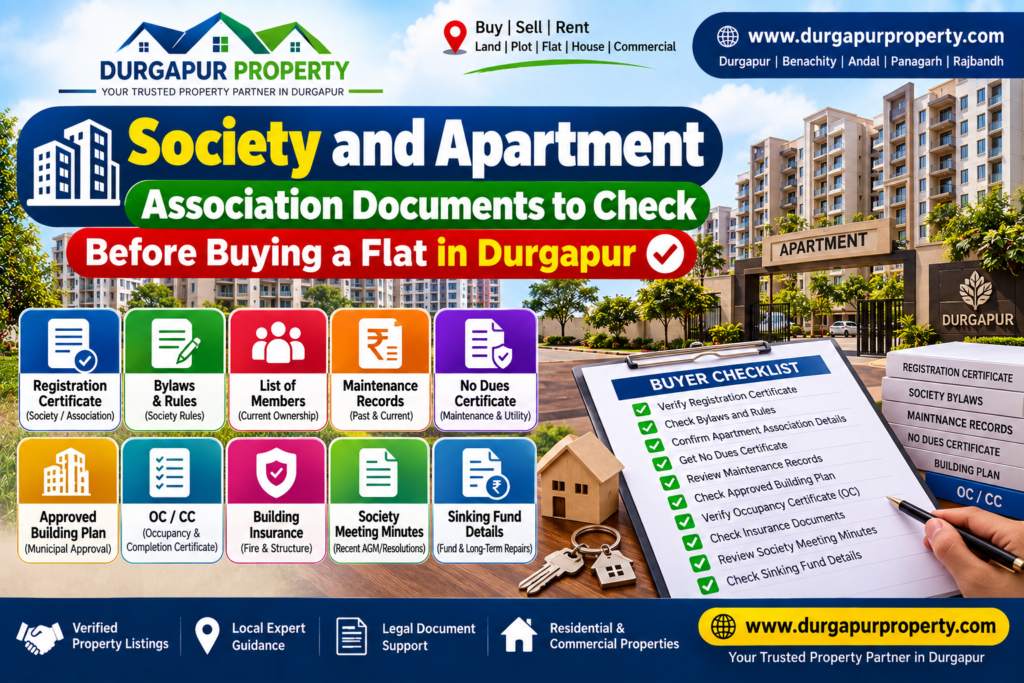
When buying a flat in Durgapur, buyers often focus on the sale deed, price, loan and physical condition of the apartment. Another important area is the building’s management and financial records. Depending on the project and its stage, a society, apartment association, owners’ association or other management arrangement may handle common areas, maintenance, utilities and shared expenses.
Why Association Documents Matter
A flat is part of a larger building ecosystem. Common corridors, lifts, parking areas, water systems, electrical infrastructure, security, waste management and repairs can create ongoing obligations. Before purchasing a resale flat, understanding the building’s management and outstanding dues can prevent surprises after possession.
1. Identify the Building’s Management Structure
Ask who currently manages the building. It may be a developer, association, society, resident committee or another arrangement depending on the project. Do not assume that every apartment building operates under the same structure.
Ask for the name of the responsible body, contact person and available written records. If a formal association exists, ask for its registration or formation documents where applicable.
2. Ask for the Latest Maintenance Statement
For a resale flat, request a recent maintenance statement showing whether dues are outstanding. Ask whether any special repair contribution has been announced but not yet collected.
A buyer should know whether an unpaid amount relates to the seller, the apartment or a common project expense. Put responsibility for outstanding dues in writing in the transaction documents.
3. Check Common Expense Categories
Ask what the regular maintenance payment covers. Typical categories can include security, cleaning, lift maintenance, common electricity, water systems, waste management, landscaping, repairs and administrative costs.
Two buildings with similar monthly charges can have very different service structures. The amount alone is less informative than what is included and how regularly charges are revised.
4. Ask About Reserve or Sinking Funds
Some buildings maintain a reserve or sinking fund for major future expenses. Ask whether such a fund exists, the approximate balance attributable to the building and how major repair decisions are funded.
Do not treat the existence of a reserve as a guarantee that future expenses will be covered. Ask about the building’s actual financial arrangements.
5. Check Major Repair History
Ask whether the building has recently completed or is planning repairs involving waterproofing, external painting, lifts, plumbing, electrical systems, roof work or structural maintenance.
If a major repair has been approved but not completed, understand the expected cost and who will pay it. A buyer should not discover a large special assessment immediately after purchase.
6. Review Meeting or Decision Records Where Available
If the building maintains minutes or written resolutions, ask for relevant records concerning major repairs, disputes, large expenditures or changes to common facilities. You do not necessarily need every historical document; focus on matters that could materially affect the apartment.
7. Check Parking Records
Ask how parking is allocated and what document identifies the space. Verify the actual parking location and whether the association has rules about visitor parking, second vehicles or changes to parking arrangements.
See also our Parking Checklist for Flat Buyers in Durgapur.
8. Ask About Water Supply
Find out whether water comes from a municipal source, borewell, building system or another arrangement. Ask about storage tanks, pumps, maintenance and any recurring supply issues.
A building with a reliable legal water arrangement and a maintained pumping system can operate differently from one that frequently depends on temporary measures.
9. Check Lift Maintenance
Ask who maintains the lifts, how often servicing is carried out and whether any major replacement is expected. If the building has an ageing lift system, a future repair expense may be relevant to the buyer.
10. Ask About Power Backup
Clarify what the backup system supports. Some buildings provide backup for lifts and common areas but not for every appliance inside the flat. Ask about generator or backup maintenance costs and coverage.
11. Check Pending Legal Disputes
Ask the seller and, where appropriate, the association about known disputes involving common areas, maintenance dues, contractors, parking or building management. A dispute does not automatically mean the property cannot be purchased, but it should be understood before committing funds.
12. Check Rules for Renovation
Some apartment buildings have written rules about structural changes, drilling, external air-conditioning units, balcony enclosures, plumbing modifications and renovation hours. Ask for applicable rules before planning alterations.
This is especially relevant if you intend to remodel the kitchen, bathrooms or internal partitions immediately after purchase.
13. Understand Move-In and Move-Out Rules
Ask whether the building charges move-in or move-out fees and whether advance notice is required. Also ask about lift protection deposits, timing restrictions and contractor entry rules.
14. Check Fire and Safety Arrangements
For applicable apartment buildings, ask about fire-safety equipment, emergency access and maintenance records. The exact compliance requirements depend on the property and applicable rules, so obtain professional advice when necessary.
15. Check Common Electricity and Utility Dues
Ask whether there are unpaid common electricity, water or maintenance bills attributable to the apartment. Make sure the final transaction documents clearly allocate responsibility for dues up to the possession or handover date.
16. Ask for a No-Dues or Clearance Confirmation
Where the building’s management provides a no-dues or clearance letter, ask the seller to obtain one before completion. The document should identify the apartment and the period covered.
A no-dues confirmation is useful because it converts a verbal statement into a written record.
17. Compare Maintenance With Building Age
Monthly maintenance should be understood in context. A newer building may have lower immediate repair requirements, while an older building may need periodic major work. Ask how charges have changed over the past few years and why.
18. Ask Existing Residents Practical Questions
Speaking respectfully with residents can reveal practical information about water supply, lift downtime, security, parking, noise, drainage and recurring repairs. Treat these comments as informal information and verify important claims through documents.
19. Prepare a Flat Association Checklist
- Management structure identified.
- Latest maintenance statement obtained.
- Outstanding dues checked.
- Major repair plans reviewed.
- Reserve or sinking fund arrangement understood.
- Parking allocation checked.
- Water and power arrangements checked.
- Lift maintenance checked.
- Known disputes asked about.
- Renovation and move-in rules understood.
- No-dues confirmation requested where available.
Common Red Flags
- The seller refuses to disclose maintenance dues.
- A large repair project is announced but its cost is unclear.
- Parking records do not match the seller’s claim.
- There are repeated lift, water or drainage complaints.
- Major common-area alterations have no clear documentation.
- Association records are unavailable despite claims of a formal association.
How to Combine Association Checks With Property Due Diligence
Association records are only one part of the transaction. Combine them with title verification, registered transaction checks, sale-deed review, building approval verification and physical inspection.
For example, our registered transaction search guide addresses another part of document due diligence, while the home-loan property buying guide explains lender-related checks.
Keep a Complete Purchase File
Keep the association statement, no-dues confirmation, parking document, repair notices, relevant rules, seller correspondence and final agreement together. If a future dispute occurs, written records are easier to rely on than memory.
Final Takeaway – Buying a Flat in Durgapur
Before buying a flat in Durgapur, understand not only the apartment itself but also the building’s management, finances and common facilities. Review maintenance dues, repair plans, parking, utilities, lift and power backup, rules, disputes and no-dues documentation. These checks can help a buyer understand the ongoing responsibilities attached to the property.
Explore Durgapur Flats and Properties
Browse property opportunities in Durgapur and complete your legal, financial and physical due diligence before buying.
Leave a Reply